School administrators and facility managers work with cleaning budgets that rarely feel adequate. The square footage is significant, the occupancy is dense, the use is intensive, and the health implications for children and staff are real. When budgets are tight, the temptation is to reduce cleaning frequency, defer maintenance, or accept lower service quality. Each of these approaches creates downstream costs — student and staff illness, accelerated facility deterioration, and eventual restoration expenses — that exceed the savings.
This guide focuses on what actually works: strategies for maximizing the value of a school cleaning budget without sacrificing the outcomes that matter most.
Understanding Where School Cleaning Budgets Go Wrong
Before addressing solutions, it helps to identify the most common ways school cleaning budgets produce poor results:
Procuring on price alone — The lowest bid rarely delivers adequate results in school settings. Vendors who win on price typically cut somewhere — labor hours, supervision, product quality, or training. The result is inconsistent service, high turnover in cleaning staff, and a facility that deteriorates faster than the contract price would suggest.
Misallocating frequency — Some schools apply the same cleaning frequency to all spaces regardless of actual use and risk. A well-maintained storage room cleaned every night alongside a high-traffic cafeteria cleaned every night represents a misallocation. Risk-based frequency decisions — more attention to high-use, high-risk areas; less to low-traffic spaces — produce better outcomes at equivalent cost.
Deferred preventive maintenance — Regular floor care maintenance — strip, wax, and polish cycles for resilient flooring; carpet extraction on schedule — prevents the much more expensive floor restoration that deferred maintenance eventually requires. The same is true of grout sealing, surface treatments, and other protective applications. Preventive maintenance is a cost reduction strategy, not a cost addition.
Inadequate restroom attention — Restrooms are the highest-health-risk and highest-complaint-generating spaces in school facilities. Under-cleaning restrooms to save money produces health outcomes (increased illness, absenteeism) and facility deterioration (unsealed grout, damaged fixtures) that cost more than the cleaning would have.
Insufficient oversight — Cleaning contracts without defined quality standards and inspection protocols often drift toward lower service levels over time. The school pays for a defined scope but receives a reduced one, with no mechanism to identify or address the gap.
Strategic Prioritization: Focus Resources Where They Matter Most
Not all school spaces carry equal cleaning priority. A practical framework for allocation:
Tier 1: Daily Thorough Cleaning Required
Restrooms — The highest-priority spaces in any school facility. Complete cleaning and disinfection at every cleaning cycle, with daytime inspection and touch-up. Paper, soap, and consumable restocking at every visit. This is the area where under-cleaning produces the most direct health consequences for students and staff.
Cafeterias and food preparation areas — High-touch, high-traffic, and food-contact surfaces require daily thorough cleaning and disinfection. Spills, crumbs, and grease accumulation are immediate pest attractants and health risks. Cafeteria floors need daily mopping; tables and seating need wipe-down after every meal period.
High-touch surfaces throughout the building — Door handles, light switches, stair rails, elevator buttons, and shared equipment surfaces should be disinfected daily regardless of which space they are in.
Gymnasium and athletic areas — Active use produces sweat, body fluids, and high bacterial loads on equipment and floor surfaces. Daily cleaning and disinfection of high-touch surfaces and equipment, with regular deep cleaning of the gym floor appropriate to its surface type.
Tier 2: Regular Cleaning with Optimized Frequency
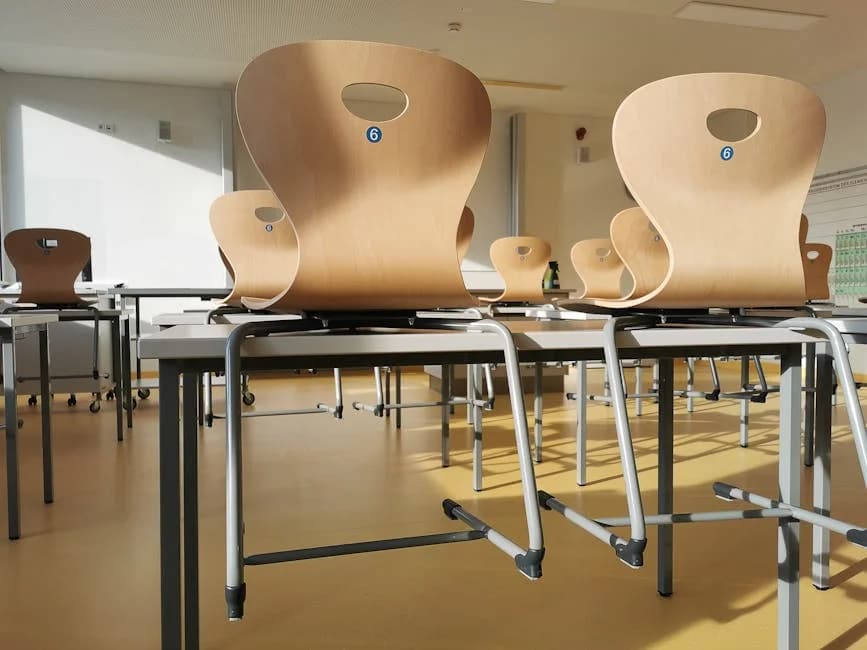
Classrooms — Daily cleaning (trash removal, high-touch disinfection, floor sweeping or vacuuming) is standard. Desk and surface disinfection frequency can be calibrated to enrollment and current illness burden rather than set at a uniform standard regardless of conditions.
Administrative and office areas — Standard office cleaning protocols. Typically lower risk than student-occupied spaces.
Corridors and common areas — Daily floor maintenance in high-traffic corridors; less frequent attention to hallways serving infrequently used areas.
Tier 3: Periodic Cleaning Appropriate
Storage areas and seldom-used spaces — Weekly or periodic cleaning rather than nightly. These spaces do not carry the same health risk or traffic load as occupied spaces.
Library stacks and archival areas — Regular but not nightly; dusting and floor maintenance on a schedule matched to use.
This tiering approach allows the cleaning budget to be concentrated where it produces the most health and facility-condition benefit.
Smart Procurement for Education Facilities
School districts and private institutions purchasing cleaning services have specific procurement considerations:
RFP Structure That Produces Comparable Bids
When education facilities issue bids without a structured scope, they receive proposals built on different assumptions — making price comparison meaningless. A well-structured Request for Proposal for school cleaning includes:
- Total gross square footage broken down by space type (classrooms, corridors, restrooms, cafeteria, gymnasium, administrative)
- Current cleaning frequency by area type
- Floor types by area (VCT, carpet, gymnasium wood or rubber, tile)
- Current pain points or areas of known inadequacy
- Required certifications or compliance standards (green cleaning, OSHA training, background checks)
- Insurance minimums and proof requirements
- Reference requirements — number, type (education), and recency
- Performance standard definitions and inspection protocol requirements
With a structured RFP, vendor bids are directly comparable, and low bids can be interrogated against specific scope elements rather than accepted or rejected on price alone.
Consortium Purchasing and Cooperative Contracts
Many state education associations and school districts participate in purchasing cooperatives — pre-negotiated contract vehicles that allow individual schools or districts to purchase services at rates negotiated across a larger buying pool. Florida has several cooperative purchasing programs available to educational institutions.
Cooperative contracts can provide competitive pricing with the benefit of pre-vetted vendors and established contract terms. However, they should not eliminate your own evaluation process — verify that the cooperative vendor's specific capabilities match your facility's needs.
Multi-Year Contracting
Cleaning companies have significant onboarding costs associated with learning a new facility, training staff on specific requirements, and building the operational knowledge that produces consistent service. When schools operate on annual contracts, vendors have less incentive to invest in this onboarding because the contract may not renew.
Multi-year contracts — typically 2–3 years — allow vendors to invest more in your facility's service because they have a longer runway to recoup that investment. In exchange, schools can negotiate price certainty (a capped annual escalation rate) and stronger performance guarantees. The net result is often better service at predictable cost.
Bundling Services
Many schools procure janitorial services, floor care, and specialty services (window cleaning, carpet extraction, exterior pressure washing) from separate vendors. This creates coordination complexity and often higher aggregate cost than bundling services with a single capable vendor who can apply shared overhead across multiple service lines.
If a vendor can credibly demonstrate capability across all the services your school needs — not just claim it, but demonstrate it with references — bundling typically produces better outcomes and often better pricing.
Eco-Friendly Cleaning: Not a Luxury in School Settings
Some school administrators treat green cleaning as an optional premium that cannot be justified in a tight budget. This framing is backward.
Green cleaning in school settings is a health requirement, not an environmental position. Children's developing respiratory and immune systems are more susceptible to chemical exposures than adults. Fragrance compounds, volatile organic compounds (VOCs), and harsh cleaning chemical residues in school environments contribute to asthma triggers, allergic reactions, and respiratory irritation in students and staff who spend the majority of their day in those spaces.
The practical requirements for school green cleaning:
- Products certified by Green Seal or EcoLogo, or included in the EPA's Safer Choice program
- Fragrance-free formulations, particularly for use in occupied spaces
- Dilution control systems that prevent overuse and reduce per-use product cost
- Microfiber cleaning systems that reduce product usage and improve pathogen removal
Many green cleaning products are now price-competitive with conventional alternatives. The incremental cost, where it exists, is justified by reduced health impact on students and staff.
Maintaining Quality Standards Without Breaking the Budget
Several practices maintain cleaning quality while keeping costs manageable:
Inspection protocols — Defined, documented quality inspections prevent scope drift. When cleaning staff know inspections happen and what is being checked, service levels are maintained more consistently. This does not require elaborate systems — a weekly walkthrough checklist by the facilities director covers the basics.
Daytime touch-up — For restrooms and cafeterias, daytime porter or custodial touch-up between evening cleaning cycles keeps high-priority spaces acceptable throughout the school day without requiring the full cleaning cycle to be repeated. This is often more cost-effective than a more frequent full cleaning schedule.
Staff awareness — When students and staff understand that their own behavior affects facility condition (and therefore cleaning cost and quality), small behavioral changes — using trash receptacles, wiping spills promptly, reporting maintenance issues — have a measurable effect on the cleaning burden.
Preventive maintenance scheduling — Work with your vendor to establish a preventive maintenance calendar that includes periodic floor restoration, carpet extraction, restroom grout sealing, and other treatments on a schedule that prevents the need for more expensive restoration work.
The Health Economics Argument
For school board members and administrators evaluating cleaning budgets against other priorities, the health economics argument is worth making explicitly.
Studies of school cleaning quality consistently show a positive correlation between cleaning standards and attendance rates. Student absenteeism due to illness has direct costs — for the school in terms of attendance-based funding, and for parents in terms of work disruption and childcare. Absenteeism costs significantly exceed the incremental cost of adequate vs. inadequate cleaning.
Staff illness has similar economics: a sick teacher means a substitute, with associated costs and educational disruption. Cleaning programs that demonstrably reduce illness transmission — primarily through consistent disinfection of high-touch surfaces and restrooms — produce measurable attendance and productivity benefits.
The argument for adequate school cleaning is not just about clean facilities. It is about maintaining the conditions that allow learning to happen.
School cleaning on a tight budget is a solvable problem — but it requires strategic prioritization, smart procurement, and a vendor relationship built on defined standards rather than just price. Contact Mega Service Solutions to discuss a school cleaning program designed around your facility's priorities and budget realities. We serve K-12 schools, colleges, and educational campuses throughout the Tampa Bay area and across Florida.
Frequently Asked Questions
What cleaning standards apply to schools and educational facilities?
K-12 schools and universities must maintain cleaning standards that protect student and staff health, comply with Florida Department of Education guidelines, and meet OSHA standards. Key priorities include restroom hygiene, classroom disinfection of high-touch surfaces, cafeteria sanitation, and gymnasium and locker room maintenance. Mega Service Solutions has experience with educational facilities of all sizes.
How often should school classrooms be professionally cleaned and disinfected?
Classrooms in active schools benefit from nightly cleaning and disinfection of desks, chairs, doorknobs, light switches, and shared equipment. Restrooms require multiple cleanings throughout the school day. Mega Service Solutions offers nightly janitorial programs for K-12 schools and universities, including summer deep cleaning programs to reset facilities before the academic year.
Does Mega Service Solutions serve businesses throughout Florida?
Yes. Mega Service Solutions is headquartered in Tampa, FL and serves businesses statewide — including Tampa, Orlando, Miami, Jacksonville, Fort Lauderdale, Clearwater, St. Petersburg, Sarasota, Fort Myers, Naples, Tallahassee, Boca Raton, and Hollywood. We also serve clients nationwide. Call (813) 501-5001 or visit megasvs.com/get-a-quote to request a free assessment.
How do I get a quote from Mega Service Solutions?
Getting a quote is simple. Call us at (813) 501-5001 (available 24/7) or submit a request at megasvs.com/get-a-quote. We'll schedule a free, no-obligation facility walkthrough, assess your needs, and provide a custom proposal within 24–48 hours. There's no commitment required.
Written by
Mega Service Solutions
Tampa’s SBE & MBE certified commercial cleaning experts. Serving 500+ businesses across Florida. Learn more about our team and commitment to quality.
About our team →