Commercial cafeterias — whether in schools, corporate campuses, healthcare facilities, government buildings, or manufacturing facilities — are among the most demanding cleaning environments in commercial settings. High-volume, rapid-cycle meal service generates mess at a rate that overwhelms standard cleaning approaches. The health and safety stakes are high because food contact is involved. And cleaning windows are tight: between meal periods, during lunch rushes, and after service closes, there is rarely as much time as a thorough cleaning job would ideally require.
This guide addresses the specific challenges of commercial cafeteria cleaning and the techniques and protocols that produce consistent results in this demanding environment.
Why Standard Cleaning Protocols Fall Short in Cafeterias
Most commercial cleaning programs are designed for controlled, predictable environments — office spaces, corridors, restrooms. Cafeterias violate the assumptions those programs are built on:
Mess generation rate — A cafeteria serving 200–500 people in 45–60 minute shifts generates significant food and beverage spills, crumbs, grease accumulation, and debris in a very short period. The volume and nature of this soiling exceeds what standard janitorial cleaning is designed to handle.
Food contact surfaces — Cafeteria tables, service counters, and tray rails are food-contact or food-adjacent surfaces. Cleaning these surfaces requires food-safe cleaners and sanitizers, not standard all-purpose cleaning products. The distinction matters both for effectiveness and for compliance.
Cross-contamination risk — Using the same equipment and materials to clean multiple surface types in a food service environment creates cross-contamination risk. Cleaning under tables and then cleaning table surfaces with the same tools; using floor mops near food prep areas; improperly storing cleaning materials near food contact surfaces — all of these are food safety failures that a professional program must prevent.
Compliance requirements — Commercial cafeterias are subject to health department inspection and food safety regulations that have specific cleaning and sanitation requirements. Failure to meet these requirements creates inspection violations, public health risk, and liability.
Tight turnaround windows — In school cafeterias, the cleaning window between lunch periods may be 15–30 minutes. In corporate cafeterias, service may transition from breakfast to lunch to mid-afternoon with limited windows for cleaning. The cleaning system must be designed to achieve the required standard within these constraints.
The Color-Coded System: Preventing Cross-Contamination
The single most important structural element of a professional cafeteria cleaning program is color coding: assigning specific colors of cleaning tools and materials to specific surface categories, and never mixing them.
A standard cafeteria color-coding system:
- Red — Restrooms and heavily contaminated areas
- Yellow — Food preparation and food contact surfaces (tables, service counters)
- Green — General kitchen areas, non-food-contact surfaces
- Blue — General low-risk areas (dining room floors, windows, office areas)
Within each color category, dedicated microfiber cloths, mop heads, squeegees, and buckets are used exclusively. They are washed separately, stored separately, and replaced on a defined schedule. A cleaner who uses the red mop on the restroom and then mops the cafeteria floor has created a cross-contamination event — with a color-coded system, this error is visible and preventable.
For cafeteria cleaning programs, microfiber is preferred over cotton mops and cloths because:
- Microfiber's fiber structure mechanically removes bacteria rather than simply moving it
- Microfiber retains less water than cotton, reducing slip risk and cleaning solution usage
- Microfiber launders at lower temperatures while still achieving sanitization, reducing utility costs
- Microfiber wears more uniformly than cotton, making replacement scheduling predictable
Between-Meal-Period Cleaning Protocol
The most demanding cleaning challenge in school and corporate cafeterias is the between-period cleaning — achieving a food-safe, presentable space in a tight window. The protocol below is designed for a 20–30 minute window with a two-person team:
Person 1 — Tables and high surfaces (begins immediately as last students/diners leave):
- Clear and consolidate tray returns or food debris at collection points
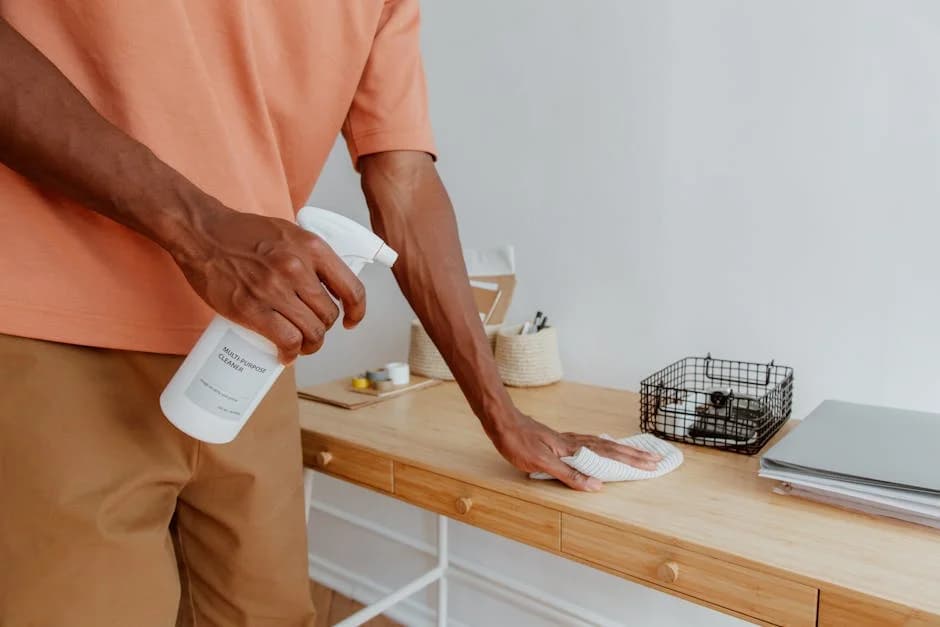
- Wipe all table surfaces with food-safe sanitizer solution — spray, 30-second dwell, wipe in single pass
- Wipe all chairs and chair rungs (a frequently skipped step that accumulates sticky residue)
- Wipe service counter surfaces and any sneeze guard panels
Person 2 — Floor (begins as soon as tables in first section are clear):
- Spot-pick large debris from floor (do not sweep over it; pick up and deposit in trash)
- Sweep remaining floor in systematic passes — cafeteria floors require a systematic approach, not random passes, to avoid missing areas
- Mop floor section by section using correct cleaning solution for the floor type
- Place wet floor signage in mopped sections during drying
Both persons — Final check (last 5 minutes):
- Verify all tables are clear and clean
- Verify floor is swept and mopped throughout
- Verify trash receptacles are emptied and relined
- Verify service station is clean and prepared for next period
This two-person protocol achieves an adequate standard in the window available. A one-person team cannot complete this in 20–30 minutes without cutting steps.
Deep Cleaning: After-Service Protocol
End-of-day or after-service deep cleaning of the cafeteria is more thorough than the between-period cleaning and addresses the accumulation that builds up through the day.
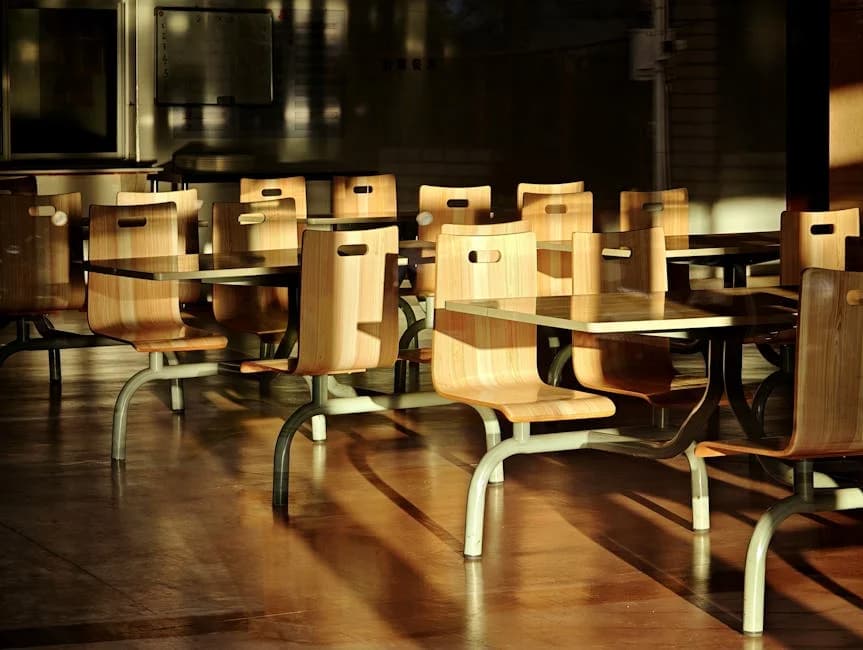
Tables and seating — Full wipe-down including undersurfaces of tables (where food frequently accumulates) and all seating surfaces. For cafeteria benches, clean the entire surface including the backrest and support structure.
Service line and equipment — Detailed cleaning of all service counter surfaces, steam table exteriors, serving utensil holders, and cash register areas. For schools and institutions with in-house food service, coordination with the food service team on who is responsible for cleaning specific equipment is important.
Floor — Full sweep and mop of the entire cafeteria floor, including under and around fixed seating where possible. High-pressure floor cleaning with an appropriate cleaning solution for the floor type — VCT, sealed concrete, tile — followed by extraction or auto-scrubber work for a more thorough result.
Floor drains — Cafeteria floor drains accumulate significant food organic matter and are a primary source of drain fly infestations and odor. Professional drain cleaning — removing the biofilm layer from inside the drain pipe, not just pouring product in — is part of a thorough deep cleaning protocol.
Walls and baseboards — Food splatter on walls and accumulation at baseboards near service stations are frequent sources of pest attraction. After-service deep cleaning should include wall spot-cleaning and thorough baseboard cleaning.
High surfaces — Ceiling-mounted fans, light fixtures, and ventilation components in cafeterias accumulate grease-laden particulate over time. Monthly attention to high surfaces as part of the deep cleaning rotation addresses this accumulation.
Cafeteria Food Safety Compliance: What Cleaning Teams Need to Know
Professional cafeteria cleaning teams operating in food service environments need working knowledge of applicable food safety requirements. Key elements:
Sanitizer concentration — Food contact surface sanitizers must be applied at the correct concentration to achieve the required log reduction in pathogen counts. Too little is ineffective; too much can leave harmful residue. Cleaning teams should use test strips to verify sanitizer concentration at the start of each shift.
Dwell time — Sanitizers require contact with the surface for a defined period to work. Applying sanitizer and immediately wiping it off does not achieve sanitization. The dwell time requirement varies by product — typically 30 seconds to 2 minutes for quaternary ammonium compounds; check product labeling.
Surface preparation before sanitizing — Sanitizers work on clean surfaces. Organic material (food residue, grease) protects microorganisms from the sanitizer. The correct sequence is: clean to remove gross soil, then sanitize. Sanitizing a visibly dirty surface does not achieve the required result.
Health department requirements — State and local health department requirements vary. Florida Department of Health and county health department regulations include specific cleaning and sanitation requirements for food service establishments. Cleaning teams in school cafeterias should have documented training on applicable Florida requirements.
Pest Prevention as Part of the Cafeteria Cleaning Program
Cafeterias are the highest-pest-risk area of any commercial building. Food debris, warmth, moisture, and consistent human activity create conditions that attract and sustain cockroaches, ants, rodents, and flies. The cleaning program is the first line of pest prevention.
Critical pest prevention practices in cafeterias:
No overnight food exposure — All food removed from service areas and properly stored. No open containers of food left on counters, in service areas, or in trash receptacles overnight.
Grease management — Grease accumulation behind and beneath cooking equipment, in service line components, and around floor drains is among the most significant pest drivers in institutional food service. This requires periodic professional equipment cleaning beyond what daily cleaning achieves.
Drain maintenance — Regular deep cleaning of cafeteria floor drains prevents the biofilm accumulation that supports drain flies.
Trash management — All trash receptacles emptied at the end of service. Exterior waste receptacles that receive cafeteria waste should be sited as far from the building as practical and kept tightly covered.
If pest activity is identified in the cafeteria, professional pest control response combined with investigation of the cleaning practices that allowed the conditions to develop is the appropriate response.
Odor Management
Cafeteria odors are a persistent complaint and a significant factor in how users perceive the space. Effective odor management in cafeterias:
Source elimination, not masking — Fragrances applied over odor sources do not solve the problem; they create a combined odor that users find unpleasant in a different way. Persistent cafeteria odors almost always have a source: drain accumulation, grease in hood systems, improperly cleaned floor mats, or food debris in inaccessible areas.
Floor drain cleaning — Drain odors are the most common source of persistent cafeteria odors. Professional drain cleaning addressing the biofilm in the drain pipe resolves drain odors in most cases.
Ventilation and hood cleaning — Cafeteria exhaust systems accumulate grease that off-gases into the space, particularly when the hood is warm. Regular hood cleaning — at intervals appropriate to the cooking volume — is the primary control for cooking odor accumulation.
Floor mat management — Entrance and service area mats in cafeterias absorb food and beverage spills and become significant odor sources if not regularly laundered or replaced.
Commercial cafeteria cleaning that produces consistent food safety compliance and a clean dining environment requires the right protocols, properly trained staff, appropriate equipment, and a cleaning schedule designed around the actual use patterns of the space.
Contact Mega Service Solutions to discuss a cafeteria cleaning program for your school, corporate campus, healthcare facility, or institutional food service operation. We build programs around your service schedule, compliance requirements, and specific facility characteristics.
Frequently Asked Questions
What is included in a professional commercial kitchen cleaning service?
Professional commercial kitchen cleaning covers hood and exhaust cleaning, equipment degreasing, floor drains, grease traps, tile and grout scrubbing, and all food-contact surfaces. Mega Service Solutions follows NFPA 96 standards for hood cleaning and uses commercial-grade degreasers safe for food service environments.
How often do commercial kitchens need to be professionally deep cleaned?
Commercial kitchens in high-volume restaurants typically require monthly hood cleaning and quarterly deep cleans of equipment and surfaces. Lower-volume operations may schedule quarterly hood cleanings. Hillsborough County health inspections evaluate kitchen cleanliness — regular professional cleaning helps maintain compliance and avoid violations.
Does Mega Service Solutions serve businesses throughout Florida?
Yes. Mega Service Solutions is headquartered in Tampa, FL and serves businesses statewide — including Tampa, Orlando, Miami, Jacksonville, Fort Lauderdale, Clearwater, St. Petersburg, Sarasota, Fort Myers, Naples, Tallahassee, Boca Raton, and Hollywood. We also serve clients nationwide. Call (813) 501-5001 or visit megasvs.com/get-a-quote to request a free assessment.
How do I get a quote from Mega Service Solutions?
Getting a quote is simple. Call us at (813) 501-5001 (available 24/7) or submit a request at megasvs.com/get-a-quote. We'll schedule a free, no-obligation facility walkthrough, assess your needs, and provide a custom proposal within 24–48 hours. There's no commitment required.
Written by
Mega Service Solutions
Tampa’s SBE & MBE certified commercial cleaning experts. Serving 500+ businesses across Florida. Learn more about our team and commitment to quality.
About our team →