Why Office Disinfection Is a Workforce Health Strategy
Germs spread efficiently in office environments. Shared spaces — conference rooms, break rooms, restrooms, reception areas — create pathways for pathogen transmission that affect every person in the building. Keyboards, phones, door handles, coffee machine controls, and printer touchscreens are touched dozens to hundreds of times per day by different people.
The result: illness that spreads through office populations reduces productivity, increases absenteeism, and creates a cycle of reduced coverage that degrades service quality and creates additional strain on the employees who remain at work.
Office disinfection is not simply a hygiene courtesy — it is a workforce health and productivity strategy with measurable business outcomes. Organizations that maintain consistent disinfection programs experience lower absenteeism and better employee satisfaction with their work environment.
Mega Service Solutions provides professional commercial cleaning and disinfection services for office environments throughout Tampa Bay.
Why Disinfection Matters in the Office
Reduces Spread of Illness
Pathogens that cause respiratory illness (influenza, rhinovirus, adenovirus) and gastrointestinal illness (norovirus, rotavirus) survive on hard surfaces for hours to days after being deposited by an infected person. Employees who touch contaminated surfaces and then touch their face — an average person does this approximately 23 times per hour — introduce pathogens directly to mucous membranes.
Disinfecting high-touch surfaces at appropriate frequency disrupts this transmission pathway. Studies consistently demonstrate that enhanced disinfection protocols in shared office environments reduce the spread of respiratory and gastrointestinal illness.
Improves Employee Morale and Perception
Employees who work in visibly clean, well-maintained environments report higher job satisfaction and greater confidence in management. The perception that an organization takes the health of its workforce seriously — demonstrated through tangible practices like professional cleaning — contributes to employee engagement and retention.
The opposite is also true: employees who work in visibly dirty or neglected environments report lower satisfaction and are more likely to seek employment elsewhere.
Enhances Professional Image
Office cleanliness affects the impression your space makes on clients, visitors, job candidates, and prospective business partners. A conference room with dusty surfaces, a reception area with dirty chairs, or a restroom that clearly has not been recently cleaned communicates organizational standards more loudly than any amount of professional decor.
Clean, disinfected office spaces communicate that the organization takes quality seriously — in its facilities and, by extension, in its work.
How to Disinfect Your Office Effectively
Step 1: Identify High-Touch Surfaces
Not all surfaces require the same disinfection frequency. High-touch surfaces — those contacted frequently by multiple people — carry the highest transmission risk and require priority attention.
High-touch surfaces in office environments include:
Entry points:
- Door handles at all building and office entrances
- Elevator buttons (interior and exterior)
- Stairwell handrails
- Reception desk surfaces and visitor sign-in equipment
Shared workspaces:
- Conference room table surfaces
- Chair armrests in conference rooms and waiting areas
- Whiteboard markers, erasers, and remote controls
- Phone handsets and keypad surfaces
- Shared printer, copier, and scanner control panels and touchscreens
Break rooms and kitchens:
- Coffee machine, microwave, and appliance controls
- Refrigerator handles
- Sink faucets and soap dispensers
- Countertop surfaces
- Communal table or seating surfaces
Restrooms:
- All fixtures and flush controls
- Door handles and stall latches
- Faucets and soap dispensers
- Paper towel dispensers
Individual workstations (for personal disinfection):
- Keyboard and mouse
- Phone handset
- Desk surface
- Chair armrests
Step 2: Choose the Right Disinfectant
Not all cleaning products are disinfectants. Cleaners remove visible soil — disinfectants kill microorganisms on surfaces. Many products do both. For office disinfection, you need products that are:
EPA-registered: EPA registration (List N for viruses, or the specific pathogen category relevant to your concern) verifies that the product has been tested and demonstrated effective against the claimed pathogens.
Appropriate for your surfaces: Certain disinfectants can damage or discolor electronics, certain metals, or specific materials. Review product label compatibility before use.
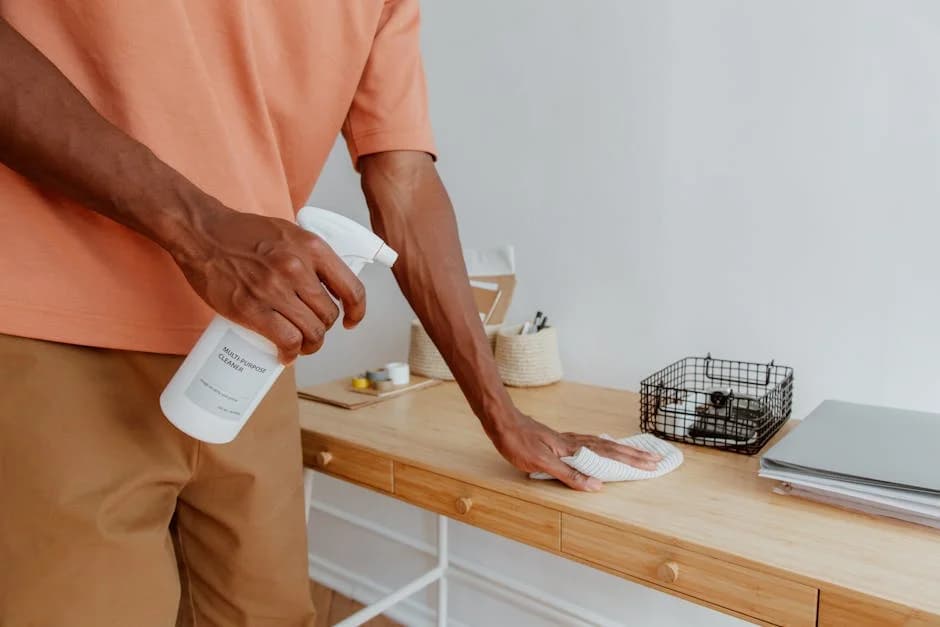
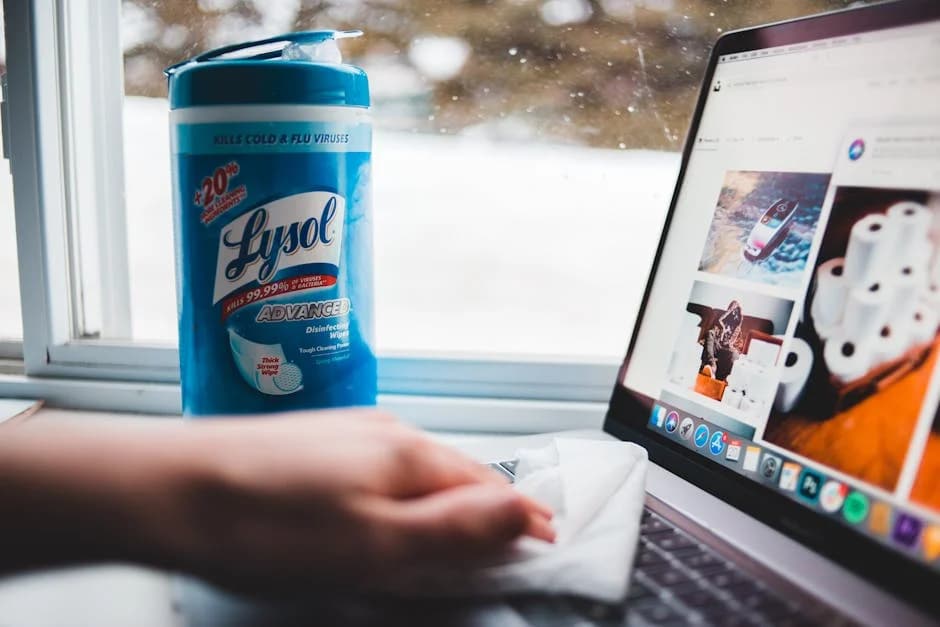
Formulated for the application: Disinfectant wipes are appropriate for spot disinfection of high-touch surfaces. Spray bottles allow more complete coverage for larger surfaces. Electrostatic sprayers provide comprehensive surface coverage for full-room disinfection.
Common office-appropriate disinfectant types:
- Quaternary ammonium (quat) compounds: Broad-spectrum, appropriate for most hard non-porous surfaces, available in wipe and spray formats
- Hydrogen peroxide-based: Effective against a broad pathogen range, generally gentle on surfaces, leaves no residue
- Alcohol-based (70% isopropyl or ethanol): Effective and fast-acting, appropriate for electronics and screens, must be used at correct concentration
Step 3: Follow Instructions for Effective Application
The most common error in office disinfection is not using products according to their label directions — particularly dwell time requirements.
Disinfectants require a specified contact time (dwell time) during which the surface must remain visibly wet to achieve the pathogen reduction claim. A product that claims a 1-minute contact time must remain wet on the surface for 60 seconds. Spraying and immediately wiping dry — the intuitive approach — does not achieve disinfection, regardless of how effective the product is.
Proper technique:
- Pre-clean visibly soiled surfaces: Organic material (dirt, food residue) deactivates many disinfectants. Remove visible soil before applying disinfectant.
- Apply product with appropriate coverage: Ensure the entire surface area is wetted.
- Allow dwell time: Do not wipe prematurely. Keep the surface wet for the full contact period specified on the label.
- Wipe or allow to air dry: Follow label direction — some products should be wiped after dwell time, others are designed to air dry.
Step 4: Establish a Disinfection Schedule
Effective office disinfection is not an event — it is a program. The appropriate schedule depends on your office's occupancy, layout, and employee density:
Daily disinfection:
- All high-touch surfaces identified above
- Restrooms — at minimum once daily, more frequently in high-traffic situations
- Break room appliance controls and surfaces
After-hours or end-of-day disinfection:
- Full workstation surface disinfection (can be coordinated with regular janitorial service)
- Floor cleaning in shared areas
Weekly disinfection:
- Conference room deep clean including all surfaces
- Break room full clean including refrigerator interior and appliance exterior
- Reception area full clean
Periodic enhanced disinfection:
- Following illness outbreaks — full facility enhanced disinfection
- Before or after large meetings or events
- Seasonal — beginning of flu season enhanced protocols
The Role of Professional Disinfection Services
In-house disinfection programs — whether conducted by employees or in-house janitorial staff — have inherent limitations:
- Inconsistent technique: Without proper training, dwell time requirements are rarely observed consistently
- Product gaps: Organizations may use familiar products that are not EPA-registered or not appropriate for the surfaces being disinfected
- Coverage gaps: Areas that are not visibly dirty tend to be skipped even when they are high-touch transmission points
- Documentation absence: In-house programs rarely maintain the cleaning records that demonstrate compliance and provide evidence of due diligence
Professional commercial cleaning and disinfection services address all of these limitations through trained technicians, appropriate product selection, systematic coverage, and documented accountability.
For facilities with elevated health concerns — medical office suites in commercial buildings, facilities housing immunocompromised employees, or organizations recovering from illness outbreaks — professional disinfection services provide the documented rigor that the situation requires.
Getting Started with Professional Office Disinfection
A well-executed office disinfection program protects your employees' health, maintains your workplace's professional appearance, and communicates organizational values through tangible action.
Contact Mega Service Solutions today to schedule a consultation. We will assess your office environment, identify your highest-priority disinfection needs, and build a program that protects your team without disrupting your operations.
Frequently Asked Questions
What is the difference between cleaning, sanitizing, and disinfecting?
Cleaning removes visible dirt and debris. Sanitizing reduces bacteria to safe levels on food-contact surfaces. Disinfecting kills a broader spectrum of pathogens — bacteria, viruses, and fungi — on surfaces. For commercial facilities, Mega Service Solutions uses EPA-registered disinfectants and electrostatic application technology to achieve thorough, documented disinfection.
How often do commercial facilities need professional disinfection services?
High-touch commercial environments — healthcare, schools, gyms, food service — benefit from daily disinfection of contact surfaces. Office environments may schedule weekly or monthly disinfection programs. Mega Service Solutions can integrate disinfection into your regular janitorial program or provide standalone services.
Does Mega Service Solutions serve businesses throughout Florida?
Yes. Mega Service Solutions is headquartered in Tampa, FL and serves businesses statewide — including Tampa, Orlando, Miami, Jacksonville, Fort Lauderdale, Clearwater, St. Petersburg, Sarasota, Fort Myers, Naples, Tallahassee, Boca Raton, and Hollywood. We also serve clients nationwide. Call (813) 501-5001 or visit megasvs.com/get-a-quote to request a free assessment.
How do I get a quote from Mega Service Solutions?
Getting a quote is simple. Call us at (813) 501-5001 (available 24/7) or submit a request at megasvs.com/get-a-quote. We'll schedule a free, no-obligation facility walkthrough, assess your needs, and provide a custom proposal within 24–48 hours. There's no commitment required.
Written by
Mega Service Solutions
Tampa’s SBE & MBE certified commercial cleaning experts. Serving 500+ businesses across Florida. Learn more about our team and commitment to quality.
About our team →