Cleaning Efficiency Is a Hotel Profitability Issue
Hotel cleaning operations represent a significant portion of labor and supply costs. In many properties, housekeeping and cleaning account for 25–35% of total operating expenses. Reducing these costs without compromising cleanliness standards — and the guest satisfaction scores that drive revenue — requires strategic thinking, not simply cutting hours or supplies.
The following seven strategies are used by well-run hotel operations to achieve more consistent, higher-quality cleaning outcomes at lower total cost. They apply to independent properties and branded hotels alike, from limited-service facilities to full-service luxury properties.
Mega Service Solutions works with hotel operators throughout Tampa Bay to implement these efficiency principles as part of comprehensive commercial cleaning programs for hospitality environments.
Strategy 1: Strategic Scheduling
The most significant driver of unnecessary cleaning labor cost is poor scheduling — specifically, mismatches between staffing levels and actual cleaning demand.
Effective scheduling for hotel cleaning operations involves:
Occupancy-based staffing: Staff levels should flex with occupancy. A 40% occupancy night requires different staffing than a 90% occupancy night. Scheduling systems that connect projected occupancy to cleaning labor requirements prevent both overstaffing on slow nights and understaffing on busy nights.
Peak and off-peak optimization: Common areas — lobbies, fitness centers, restaurants — see predictably higher traffic at specific times of day. Scheduling cleaning and maintenance in the transitions between peak periods maximizes efficiency and minimizes disruption to guests.
Overtime control: Unplanned overtime is one of the most expensive outcomes of poor scheduling. Consistent scheduling practices, adequate coverage planning, and cross-training (see Strategy 4) reduce the frequency of overtime situations.
Night shift utilization: Many deep cleaning tasks — lobby floor maintenance, commercial kitchen cleaning, conference room deep cleaning — are best performed overnight when facilities are not in active use. Scheduling appropriate cleaning activities for off-hours improves both efficiency and guest experience.
Strategy 2: Smart Inventory Management
Cleaning supply costs in a hotel escalate quickly when inventory is poorly managed. Common problems include:
- Overstocking of some items while running out of others (creating emergency purchases at higher cost)
- Product dilution errors that waste chemical concentrate
- Theft or unauthorized use of cleaning supplies
- Use of premium products for applications where basic products are adequate
An effective inventory management system tracks usage by product and area, connects consumption to occupancy and cleaning frequency, and identifies anomalies that indicate waste or misuse.
Product consolidation: Reducing the number of different cleaning products in use simplifies training, reduces storage requirements, and creates volume purchasing opportunities. Many facilities use far more product variety than necessary — often because products accumulate over time without systematic rationalization.
Dilution control systems: Wall-mounted dispensing systems that automatically dilute concentrate to the correct ratio eliminate the dosing errors that waste product and reduce cleaning effectiveness.
Par level management: Setting par levels for each cleaning supply — the minimum quantity that triggers reorder — prevents both stockouts and excessive inventory accumulation.
Strategy 3: Technology Integration
Technology investments in hotel cleaning operations typically produce measurable returns:
Property management system integration: Connecting housekeeping management software with the property management system allows real-time tracking of room status, departure schedules, and check-in priorities. Staff spend less time coordinating and more time cleaning.
Inspection and quality management apps: Digital inspection tools replace paper checklists with mobile apps that document inspection results, flag issues, and track completion rates. The data these tools generate identifies patterns — recurring problem areas, individual performance variations, time-per-room trends — that enable continuous improvement.
Energy-efficient cleaning equipment: Modern commercial cleaning equipment uses less water and energy than older alternatives. Auto-scrubbers with recovery tanks use a fraction of the water required for traditional mop-and-bucket cleaning and produce consistently cleaner results.
Automated reporting: Automated reporting on cleaning hours, supply consumption, and quality inspection scores reduces management time spent on data collection and analysis.
Strategy 4: Cross-Training Staff
Highly specialized cleaning roles — a staff member who only cleans rooms, another who only cleans common areas — create inflexibility that drives overtime and coverage costs when absences occur.
Cross-training hotel cleaning staff in multiple areas and task types creates a flexible workforce that can be deployed where demand requires it on any given shift. Cross-trained staff who can move between room cleaning and common area maintenance smooth out workload fluctuations without requiring additional headcount or overtime.
Cross-training also develops staff capability and creates advancement pathways — contributing to retention in an industry with historically high turnover.
Strategy 5: Energy-Efficient Practices
Cleaning operations consume energy and water. Practices that reduce consumption lower operating costs while supporting the sustainability commitments many hotels have made:
Microfiber technology: Microfiber cleaning cloths and mops require significantly less water and chemical than traditional cotton materials to achieve comparable cleaning results. They are also more durable — lasting hundreds of wash cycles versus dozens for cotton equivalents.
Cold-water cleaning programs: Many modern cleaning products are formulated to achieve full efficacy in cold water, eliminating the energy cost of heating water for general cleaning applications.
Efficient lighting practices: Cleaning staff who move systematically through spaces rather than cleaning all lights on in large areas simultaneously reduce electricity consumption.
Water-efficient equipment: Walk-behind and ride-on auto-scrubbers use a fraction of the water consumed by mop-and-bucket cleaning for equivalent floor areas.
Strategy 6: Regular Preventive Maintenance
The connection between cleaning and maintenance costs is direct: surfaces and equipment that are not properly cleaned deteriorate faster and require more expensive maintenance intervention sooner.
Carpets that receive regular extraction cleaning last significantly longer than those that are only vacuumed. Tile grout that is maintained with proper sealing and periodic deep cleaning does not require the expensive restoration work that neglected grout eventually demands. Bathroom fixtures that are regularly descaled do not require replacement due to mineral buildup damage.
Connecting cleaning schedules to preventive maintenance cycles — ensuring that areas are cleaned before maintenance work is performed and that maintenance observations are communicated back to cleaning management — creates a coordinated approach that extends asset life and reduces capital expenditure.
Strategy 7: Outsource Specialized Tasks
Some hotel cleaning tasks are most cost-effectively handled by specialized commercial cleaning contractors rather than in-house staff:
- Deep cleaning and carpet extraction — requires professional equipment and trained technicians; scheduling in-house staff for periodic deep cleaning disrupts regular workflows
- Exterior and pressure washing — specialized equipment and technique; infrequent enough that ownership is not cost-justified for most properties
- Window cleaning — particularly for high-access situations requiring specialized equipment
- Commercial kitchen cleaning — demanding environments with regulatory requirements that benefit from specialist contractor involvement
- Hood cleaning and exhaust systems — fire code compliance requirements make this a mandatory specialty contractor engagement
Our commercial cleaning services for hotels include both ongoing support and specialized periodic services that complement in-house housekeeping operations.
The Case for a Professional Cleaning Partnership
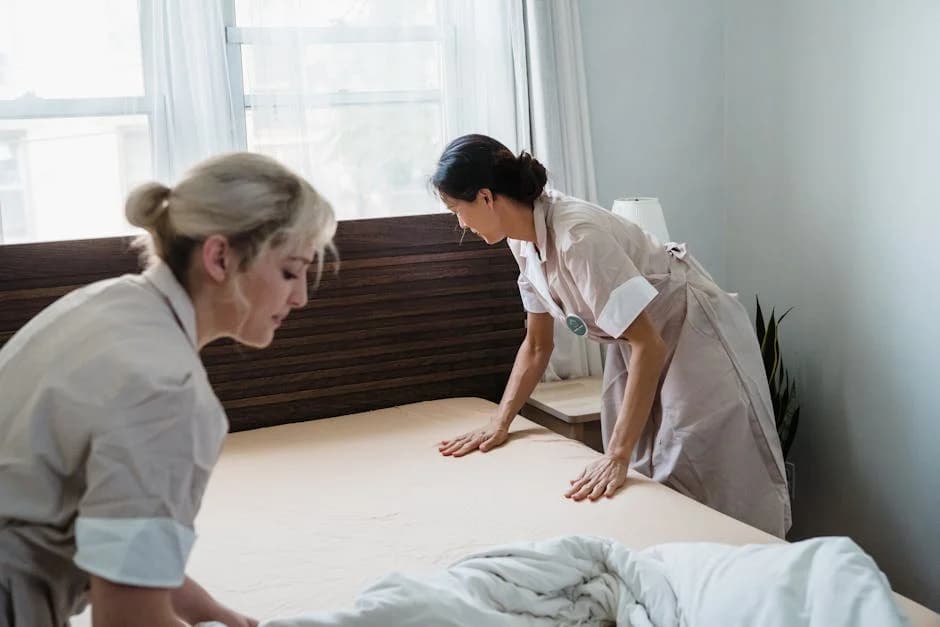
Many hotels find that partnering with a professional commercial cleaning service for common areas and specialty services — while maintaining in-house housekeeping for guest rooms — delivers the best combination of cost efficiency and quality consistency.
This model:
- Frees housekeeping staff to focus on guest room turnover (their highest-value task)
- Provides access to professional equipment and expertise for specialized areas
- Creates documented accountability through a formal service contract
- Reduces management burden associated with scheduling, training, and quality oversight for common area cleaning
Mega Service Solutions works with hotel operators to develop cleaning programs that fit this model — supporting in-house operations with professional services for common areas, specialty cleaning, and periodic deep cleaning.
Contact us today to schedule a consultation. We will assess your current cleaning operations and identify opportunities to improve efficiency, reduce costs, and maintain the cleanliness standards your guests expect.
Frequently Asked Questions
What does professional hotel cleaning cover?
Hotel cleaning services from Mega Service Solutions cover public areas (lobby, corridors, elevators, fitness center, pool areas), back-of-house (laundry, kitchen, staff areas), and can supplement housekeeping with deep cleaning programs for guest rooms, carpets, upholstery, and hard floors. We work around your operations schedule.
How do hotels maintain consistent cleanliness standards across a large property?
Consistent standards require documented cleaning protocols, trained and accountable cleaning staff, quality inspection systems, and the right equipment and products for each area. Mega Service Solutions implements standardized procedures with documented QC checks at each visit, giving property managers visibility into service completion.
Does Mega Service Solutions serve businesses throughout Florida?
Yes. Mega Service Solutions is headquartered in Tampa, FL and serves businesses statewide — including Tampa, Orlando, Miami, Jacksonville, Fort Lauderdale, Clearwater, St. Petersburg, Sarasota, Fort Myers, Naples, Tallahassee, Boca Raton, and Hollywood. We also serve clients nationwide. Call (813) 501-5001 or visit megasvs.com/get-a-quote to request a free assessment.
How do I get a quote from Mega Service Solutions?
Getting a quote is simple. Call us at (813) 501-5001 (available 24/7) or submit a request at megasvs.com/get-a-quote. We'll schedule a free, no-obligation facility walkthrough, assess your needs, and provide a custom proposal within 24–48 hours. There's no commitment required.
Written by
Mega Service Solutions
Tampa’s SBE & MBE certified commercial cleaning experts. Serving 500+ businesses across Florida. Learn more about our team and commitment to quality.
About our team →