
The phrase "eco-friendly cleaning" appears in enough vendor marketing materials that it risks becoming meaningless. Used without specifics, it is a positioning claim rather than a service description. But the underlying practices — certified green products, reduced chemical volumes, HEPA filtration equipment, microfiber systems — have genuine, measurable advantages for businesses and building occupants that deserve a clear-eyed examination.
This post defines what eco-friendly commercial cleaning actually involves, what the specific advantages are, and what to ask when a vendor claims to provide it.
What Eco-Friendly Commercial Cleaning Actually Is
Eco-friendly or green commercial cleaning is characterized by several specific, verifiable practices:
Certified product selection: Green cleaning products used in commercial settings are verified through independent certification programs including EPA Safer Choice, Green Seal (GS-37 for institutional cleaning products), and UL EcoLogo. These programs evaluate the full ingredient list — active ingredients, solvents, fragrances, preservatives, and packaging — against environmental and toxicological criteria. Certification is not self-reported; it is independently verified.
Concentrated product systems with controlled dilution: Rather than pre-mixed products shipped largely as water, green cleaning programs typically use highly concentrated products dispensed through controlled-dilution equipment. This significantly reduces packaging waste, transportation impact, and product cost per use. Controlled dilution also ensures consistent concentration — preventing both the waste of over-diluted product and the safety risks of over-concentrated solutions.
Microfiber cleaning systems: Microfiber cloths and mops trap significantly more particulate matter and bacteria than conventional cotton materials, and require significantly less chemical product to achieve effective cleaning. A microfiber cloth can clean surfaces effectively with plain water in many applications, reducing chemical use further.
HEPA-filter vacuum equipment: Standard commercial vacuums recirculate fine particulates through their exhaust. HEPA filtration captures particles down to 0.3 microns — including most biological particulates, allergens, and fine dust — preventing them from being redistributed into building air. This is the most direct equipment-level contributor to indoor air quality improvement from cleaning.
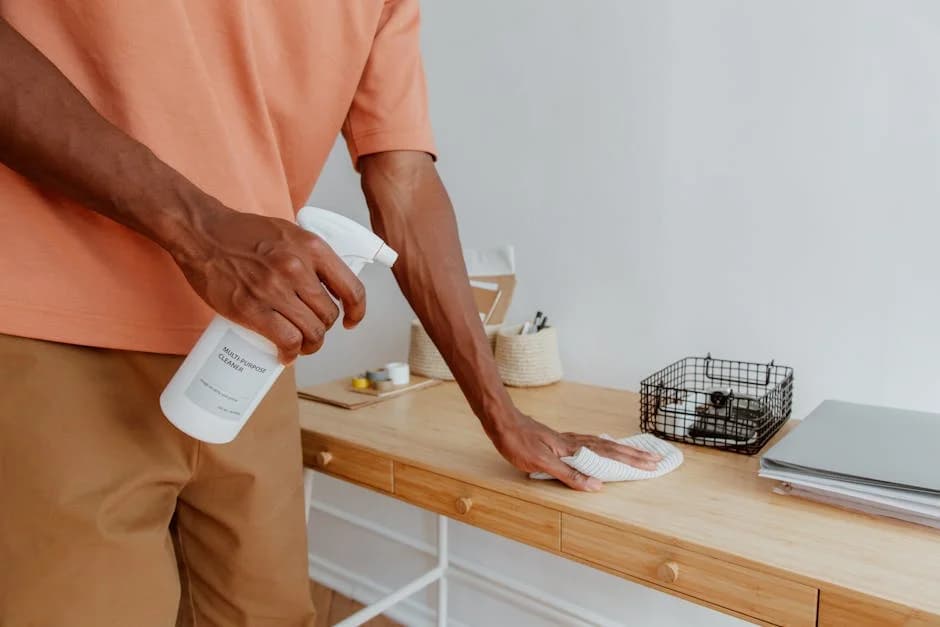
Reduced water consumption: Green cleaning programs emphasize water efficiency — wringing microfiber mops to near-dry application, using spray bottles rather than bucket-and-mop for targeted applications, and avoiding runoff from excess water application that requires additional drainage handling.
Advantage 1: Healthier Indoor Air Quality
The most significant and most documented advantage of eco-friendly commercial cleaning is improved indoor air quality.
Conventional cleaning products release volatile organic compounds (VOCs) during and after application. These include glycol ethers, chlorinated solvents, ammonia compounds, and synthetic fragrances — all of which off-gas into indoor air and persist in enclosed, recirculated building environments. The EPA consistently ranks indoor air as more polluted than outdoor air for VOC concentration, and cleaning product off-gassing is a significant contributor.
For occupants of commercial buildings, this matters directly. People who spend eight or more hours daily in cleaned commercial spaces are continuously exposed to the residual chemistry from cleaning products applied at night. For employees with asthma, allergies, or chemical sensitivities — a significant portion of any large workforce — this exposure can be the difference between comfort and daily symptoms.
Green-certified products formulated without high-VOC compounds, synthetic fragrances, and harmful solvents reduce this exposure substantially. The indoor air quality improvement is directly measurable and directly relevant to occupant health.
Advantage 2: Reduced Occupational Health Risk for Cleaning Staff
Cleaning staff have the highest occupational exposure to cleaning chemicals of anyone in a building. Research consistently documents elevated rates of occupational asthma and respiratory disease among commercial cleaning workers — attributed in significant part to routine chemical exposure without adequate ventilation or protective equipment.
Green cleaning products with lower toxicological profiles reduce this occupational risk. Formulations without high-concentration alkaline or acidic components, without solvent carriers that require respiratory protection, and without sensitizing fragrances create safer working conditions for the people performing the cleaning.
This is both an ethical consideration and a practical business factor. Professional janitorial service vendors who use safer products generally report lower worker health claims and lower turnover — better for their business and better for yours, since staff continuity in cleaning services directly affects service quality consistency.
Advantage 3: Surface Compatibility and Asset Protection
Highly caustic conventional cleaning products can damage building surfaces over time. Alkaline strippers used where neutral cleaners are appropriate attack floor finishes prematurely. Bleach-based products used on stainless steel cause pitting and corrosion. Acidic descalers used on stone surfaces etch the finish.
Green cleaning products are generally formulated to be surface-compatible at the standard dilution recommended — which means they clean without the surface damage that poorly chosen conventional products cause. This surface compatibility extends the life of flooring finishes, fixtures, and finishes, reducing the frequency of floor care services needed to restore damaged surfaces and extending the interval before fixture or finish replacement.
Over a multi-year building maintenance horizon, the reduced surface damage from appropriate product use translates to measurable capital cost savings.
Advantage 4: Support for Green Building Certification
Commercial buildings seeking or maintaining LEED (Leadership in Energy and Environmental Design) certification are evaluated on their environmental cleaning program. LEED v4 criteria under Indoor Environmental Quality assess cleaning product selection, equipment standards (including HEPA filtration), and cleaning procedures as part of the overall indoor environment evaluation.
For building owners and property managers who have invested in LEED certification, the cleaning program is a component of maintaining that certification — not an optional add-on. Working with a cleaning vendor who cannot document certified product use and appropriate equipment standards creates a gap in the certification record.
Even for buildings without formal LEED certification, the criteria serve as a useful benchmark for what high-quality indoor environmental standards require. Vendors who meet LEED criteria are demonstrably operating at a higher standard than those who do not.
Advantage 5: Alignment with Corporate Sustainability Goals
Many businesses now operate with formal environmental, social, and governance (ESG) commitments or sustainability goals that are reported to stakeholders, clients, or investors. The cleaning program for commercial facilities is a practical component of those commitments.
A vendor using certified green products, operating with reduced water and chemical volumes, minimizing packaging waste, and using energy-efficient equipment allows the facility to include cleaning operations in its sustainability reporting with documented, verifiable backing. Vendor marketing claims without certification are not a substitute — sustainability reporting requires substantiable specifics.
For businesses where ESG performance affects investor relations, client relationships, or talent attraction, the cleaning program's environmental credentials are a legitimate business consideration.
Advantage 6: Reduced Regulatory and Chemical Liability Exposure
Commercial facilities that use or store significant quantities of conventional cleaning chemicals face regulatory obligations — OSHA Hazard Communication Standard requirements, Safety Data Sheet maintenance, employee training requirements, and in some cases chemical inventory reporting.
Green cleaning programs that reduce chemical volume, use products with lower hazard classifications, and minimize the need for protective equipment reduce the compliance burden and the associated regulatory exposure. A building using highly concentrated conventional chemicals faces a different occupational safety management obligation than one using certified green products with lower hazard profiles.
Additionally, incidents involving chemical exposure — spills, accidental inhalation, skin contact — create workers' compensation and liability exposure. Products with lower hazard profiles reduce the severity of potential incidents.
What to Ask When Evaluating Eco-Friendly Cleaning Claims
Vendor claims about green cleaning should be evaluated against specific questions:
What certification programs are the products certified under? Ask for EPA Safer Choice registration numbers, Green Seal certification numbers, or UL EcoLogo documentation. Independently verifiable certification is distinct from marketing language.
What vacuum equipment is used, and does it include HEPA filtration? This is a binary question with a specific answer — either the equipment has HEPA filtration or it does not.
Are concentrated products used with controlled-dilution dispensing, or pre-mixed products? Concentrated products with dilution systems represent a genuine commitment to reducing chemical volume.
What microfiber products are used, and how are they laundered between uses? Microfiber cloths contaminated from a previous use and not laundered between uses create cross-contamination issues. A professional vendor has a documented system for managing microfiber laundering and zoning.
What is the product selection for disinfection tasks? Not all green cleaning products are also registered disinfectants. Understand what products are used when disinfection (not just cleaning) is required, and verify their EPA registration.
A vendor who can answer these questions specifically and provide documentation is genuinely operating a green cleaning program. A vendor who responds with generalities about being eco-friendly without specifics is using the language without the substance.
Mega Service Solutions provides eco-friendly commercial cleaning services using certified products, HEPA-filter equipment, and microfiber cleaning systems throughout Tampa Bay. We can support your building's sustainability documentation with specific product information and certifications. Request a quote to discuss how a green cleaning program would work for your facility.
Frequently Asked Questions
What makes a commercial cleaning program 'green' or eco-friendly?
Green commercial cleaning uses EPA Safer Choice certified or equivalent products, microfiber technology that reduces chemical usage, concentrated formulas that minimize packaging waste, and HEPA filtration equipment that captures rather than redistributes particulates. Mega Service Solutions can customize a green cleaning program for facilities seeking LEED compliance or sustainability goals.
Is green cleaning as effective as conventional cleaning?
Yes. Modern green cleaning products and methods are as effective as conventional alternatives for most commercial applications. EPA Safer Choice certified disinfectants meet the same efficacy standards as conventional products. Mega Service Solutions uses green options that deliver the same results with reduced environmental and health impact.
Does Mega Service Solutions serve businesses throughout Florida?
Yes. Mega Service Solutions is headquartered in Tampa, FL and serves businesses statewide — including Tampa, Orlando, Miami, Jacksonville, Fort Lauderdale, Clearwater, St. Petersburg, Sarasota, Fort Myers, Naples, Tallahassee, Boca Raton, and Hollywood. We also serve clients nationwide. Call (813) 501-5001 or visit megasvs.com/get-a-quote to request a free assessment.
How do I get a quote from Mega Service Solutions?
Getting a quote is simple. Call us at (813) 501-5001 (available 24/7) or submit a request at megasvs.com/get-a-quote. We'll schedule a free, no-obligation facility walkthrough, assess your needs, and provide a custom proposal within 24–48 hours. There's no commitment required.
Written by
Mega Service Solutions
Tampa’s SBE & MBE certified commercial cleaning experts. Serving 500+ businesses across Florida. Learn more about our team and commitment to quality.
About our team →