Healthcare Compliance: The Regulatory Landscape
Healthcare facilities operate in one of the most heavily regulated environments in any industry. Cleaning and environmental hygiene are not peripheral concerns — they are central to the regulatory frameworks that govern healthcare operations. Failure to maintain documented, compliant cleaning standards exposes facilities to citations, loss of accreditation, exclusion from Medicare and Medicaid programs, and civil liability.
The complexity of healthcare cleaning compliance stems from the convergence of multiple regulatory frameworks, each with specific requirements:
- OSHA — Occupational safety requirements including bloodborne pathogen handling, chemical safety, and PPE
- CDC guidelines — Infection control recommendations that inform accreditation standards
- CMS Conditions of Participation — Requirements for facilities participating in Medicare and Medicaid
- Joint Commission — Accreditation standards for hospitals and other healthcare facilities
- State health departments — Jurisdiction-specific licensing and inspection requirements
- EPA — Product registration requirements for disinfectants used in healthcare settings
Mega Service Solutions provides compliance cleaning services for healthcare facilities that are built around these regulatory requirements — not adapted from general commercial cleaning programs.
Staying Current with Healthcare Regulations
One of the most significant challenges in healthcare cleaning compliance is the frequency with which guidance and requirements change. Infection control recommendations evolve as new research emerges. Regulatory standards are updated through rulemaking and interpretive guidance. State requirements change through legislative and administrative processes.
Staying current requires:
- Active monitoring of updates from OSHA, CDC, CMS, and state health departments
- Regular review of accreditation standards from The Joint Commission, AAAHC, and other bodies
- Updating cleaning protocols when relevant guidance changes
- Training staff on changed protocols — not just initial onboarding
Professional healthcare cleaning service providers maintain this regulatory awareness as a core operational function. The cleaning protocols they implement reflect current requirements — which is not always the case for in-house cleaning programs where training updates may lag regulatory changes.
Industry-Specific Training Requirements
Healthcare cleaning requires specific knowledge that general commercial cleaning training does not provide. Staff working in clinical environments must understand:
Infection control principles: How healthcare-associated infections (HAIs) spread, which surfaces and practices pose the highest risk, and how cleaning and disinfection interrupt transmission pathways.
Bloodborne pathogen handling: OSHA's Bloodborne Pathogens Standard (29 CFR 1910.1030) applies to any employee who may reasonably be expected to come into contact with blood or other potentially infectious materials (OPIM) during the performance of their duties. For healthcare cleaning staff, this is a baseline requirement — not an advanced certification.
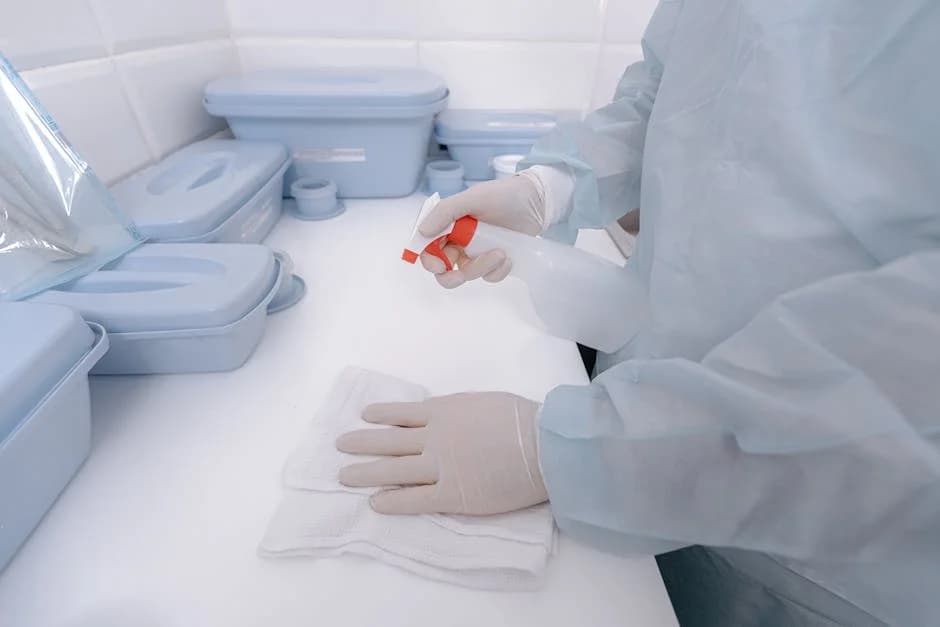
PPE selection and use: Different areas of a healthcare facility require different levels of PPE. Cleaning staff must understand which PPE is required for each area they service and how to properly don, use, and doff protective equipment.
Product knowledge: Healthcare cleaning staff must know the appropriate product for each surface and pathogen type, the required dwell time for efficacy, the proper dilution ratio, and the storage and disposal requirements for each chemical they use.
Color-coded cleaning systems: Using separate, clearly color-coded tools for different areas — restrooms, patient rooms, common areas — prevents cross-contamination between areas with different infection risk levels.
Comprehensive Cleaning Plans for Healthcare Environments
Regulatory compliance in healthcare cleaning cannot be achieved with generic cleaning programs. Each facility requires a customized plan that addresses:
Frequency requirements by area: High-touch surfaces in patient rooms, restrooms, and common areas require more frequent cleaning than low-traffic storage areas. The cleaning frequency for each area must be documented and consistently executed.
Procedure-specific requirements: Isolation room cleaning, terminal cleaning after patient discharge, and cleaning before and between surgical procedures all have specific requirements that differ from routine daily cleaning.
Product specifications: Only EPA-registered disinfectants should be used in healthcare cleaning. Product selection must be appropriate for the specific pathogens of concern in each area. Healthcare facilities dealing with C. difficile outbreaks, MRSA, or other specific pathogens require products with documented efficacy against those organisms.
Documentation requirements: Cleaning logs, inspection records, and chemical use documentation must be maintained in formats that satisfy regulatory and accreditation reviewer requirements.
Specialized Procedures for Healthcare Cleaning Excellence
Hospital-Grade Disinfectants
The EPA's List N identifies disinfectants registered for use against specific pathogens. Healthcare cleaning programs must use products from appropriate EPA lists for the organisms of concern. Using a disinfectant that is not rated for the specific pathogen — regardless of how familiar or accessible it is — does not constitute compliance.
Hospital-grade disinfectants must be applied correctly: pre-cleaned surfaces (organic material deactivates most disinfectants), proper concentration, and full dwell time before wiping.
Advanced Cleaning Equipment
Healthcare environments benefit from cleaning technologies that improve thoroughness and efficiency:
- Electrostatic sprayers — for comprehensive surface coverage in patient rooms and common areas
- UV-C disinfection systems — adjunct technology for high-risk areas like isolation rooms
- HEPA-filtered vacuums — preventing redistribution of captured pathogens during cleaning
- Microfiber systems — superior pathogen capture versus cotton materials
Sterilization Support
Healthcare cleaning extends to supporting sterilization of medical instruments and reusable equipment. Environmental services staff in clinical settings may be involved in pre-cleaning of instruments prior to central sterile processing, requiring specific training and protocol adherence.
The Risk of Inadequate Healthcare Compliance
Healthcare facilities that fail to maintain compliant cleaning standards face consequences that extend well beyond inspection citations:
Healthcare-associated infections (HAIs): HAIs cause approximately 100,000 deaths annually in the United States and generate billions of dollars in additional healthcare costs. Environmental hygiene is directly linked to HAI prevention.
Regulatory consequences: OSHA citations can reach $15,625 per serious violation. CMS can impose civil monetary penalties, deny payment, and in extreme cases, terminate provider agreements. Joint Commission deficiencies can jeopardize accreditation.
Legal liability: HAIs or other infection events attributable to inadequate environmental hygiene create medical malpractice and negligence exposure.
Reputational harm: Healthcare facilities increasingly compete on quality and safety metrics that are publicly reported. Infection rates and environmental quality deficiencies visible on public reporting platforms affect patient choice and referral patterns.
Why Healthcare Facilities Choose Professional Cleaning Partners
The regulatory complexity, training requirements, product knowledge demands, and documentation obligations of healthcare compliance cleaning create a strong case for professional service partnerships:
Maintained regulatory knowledge: Professional healthcare cleaning companies invest in staying current with regulatory requirements as a core operational function.
Pre-trained, certified staff: Healthcare cleaning technicians arrive with appropriate baseline training rather than requiring facility investment in training programs.
Comprehensive insurance: Professional cleaning contractors carry insurance coverage appropriate for clinical environments, including completed operations and professional liability coverage.
Documented accountability: Service contracts with professional cleaning companies include defined scopes of work, inspection protocols, and documentation requirements that support compliance demonstration.
Operational flexibility: Professional contractors can scale staffing to meet variable demands — increased cleaning needs during disease outbreaks, facility expansions, or accreditation preparation periods.
Partnering with Mega Service Solutions for Healthcare Compliance
Mega Service Solutions provides healthcare cleaning services built around the regulatory requirements of clinical environments. Our team undergoes healthcare-specific training in infection control, bloodborne pathogen handling, and PPE requirements. Our cleaning programs use only EPA-registered disinfectants appropriate for healthcare use, applied according to documented protocols with recorded dwell times and surface coverage.
Our documentation systems provide healthcare facility administrators with the cleaning logs, inspection records, and chemical use documentation that regulatory and accreditation reviewers require.
Contact us today to schedule a healthcare facility assessment and consultation. We will evaluate your current cleaning program against applicable regulatory requirements and develop a comprehensive compliance cleaning plan for your facility.
Frequently Asked Questions
What cleaning standards apply to healthcare facilities in Florida?
Florida healthcare facilities are regulated by the Agency for Health Care Administration (AHCA) and must meet infection control standards including OSHA bloodborne pathogen protocols, CDC environmental hygiene guidelines, and accreditation standards from The Joint Commission or AAAHC. Mega Service Solutions trains crews in healthcare-specific protocols and uses EPA-registered hospital-grade disinfectants.
How is cleaning a medical facility different from regular commercial cleaning?
Healthcare cleaning requires higher disinfection standards, proper handling of potentially contaminated materials, knowledge of infection control zones, and use of hospital-grade products. Technicians must understand isolation room protocols, sterile field boundaries, and proper PPE usage. Mega Service Solutions specializes in healthcare cleaning with trained, background-checked crews.
Does Mega Service Solutions serve businesses throughout Florida?
Yes. Mega Service Solutions is headquartered in Tampa, FL and serves businesses statewide — including Tampa, Orlando, Miami, Jacksonville, Fort Lauderdale, Clearwater, St. Petersburg, Sarasota, Fort Myers, Naples, Tallahassee, Boca Raton, and Hollywood. We also serve clients nationwide. Call (813) 501-5001 or visit megasvs.com/get-a-quote to request a free assessment.
How do I get a quote from Mega Service Solutions?
Getting a quote is simple. Call us at (813) 501-5001 (available 24/7) or submit a request at megasvs.com/get-a-quote. We'll schedule a free, no-obligation facility walkthrough, assess your needs, and provide a custom proposal within 24–48 hours. There's no commitment required.
Written by
Mega Service Solutions
Tampa’s SBE & MBE certified commercial cleaning experts. Serving 500+ businesses across Florida. Learn more about our team and commitment to quality.
About our team →