The Stakes of Healthcare Facility Hygiene
Healthcare facilities are where people come to recover from illness and injury — often with compromised immune systems that make them particularly vulnerable to infectious organisms. The environment that surrounds them either supports their recovery or adds to their risk. This is not an abstract statement. Healthcare-associated infections (HAIs) cause approximately 100,000 deaths annually in the United States and generate tens of billions of dollars in additional healthcare costs.
Environmental hygiene — how healthcare facilities are cleaned and disinfected — is directly linked to HAI rates. Research consistently demonstrates that rigorous environmental cleaning protocols reduce pathogen transmission and lower HAI incidence. This makes healthcare cleaning one of the few facility maintenance functions with direct, measurable impact on patient outcomes.
Mega Service Solutions provides specialized cleaning services for healthcare facilities, with training, protocols, and products calibrated to clinical requirements.
Preventive Measures for a Healthier Healthcare Facility
Beyond the cleaning program itself, several operational practices support environmental hygiene:
Hand hygiene infrastructure: The most effective single intervention for infection control is proper hand hygiene. Healthcare facilities should provide hand sanitizer dispensers at every patient room entrance, at nursing stations, and throughout common areas. Dispenser availability and refill must be monitored as part of facility maintenance.
Respiratory hygiene: Providing tissues and appropriate disposal containers at entrances and waiting areas, with signage encouraging proper cough and sneeze hygiene, reduces respiratory transmission through facility air.
PPE availability: Consistent availability of appropriate PPE for staff who enter patient care areas is an infection control function that environmental services must support — ensuring that storage areas and dispensing stations maintain adequate stock.
Regular cleaning and disinfection: The cleaning program itself is the core preventive measure. Comprehensive, consistently executed cleaning and disinfection of all surfaces — using appropriate products at appropriate frequencies — is the environmental foundation of infection control.
Hospital Cleaning Procedures and Methods
Terminal Room Cleaning
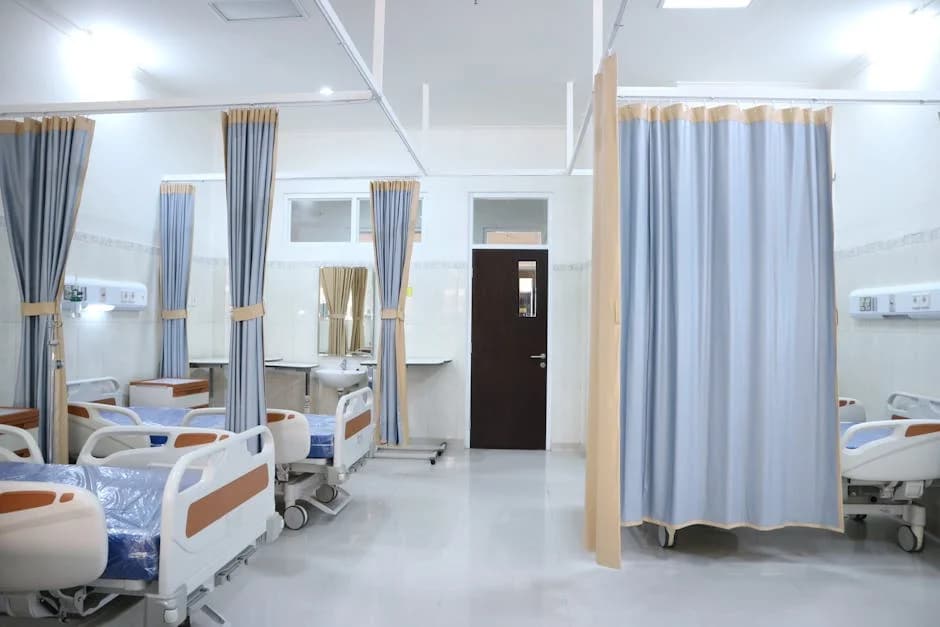
Terminal cleaning — the comprehensive disinfection of a patient room after discharge — is one of the most critical cleaning events in any healthcare facility. Research has documented that pathogens from a previous patient can survive on surfaces in a room for days to weeks after discharge, creating risk for the next patient admitted to that room.
A complete terminal room cleaning process includes:
Preparation:
- Assemble all cleaning supplies including color-coded tools designated for patient room use
- Don appropriate PPE before entering
- Remove all disposable items from the room
High-level disinfection of all surfaces: Working systematically from the cleanest areas to the most contaminated (typically restroom last), disinfect every surface in the room:
- Bed rails, mattress surface and underside, and bed frame
- Call button and TV remote
- Over-bed table, upper and lower surfaces
- Bedside cabinet and contents area
- All medical equipment surfaces
- IV pole, wheelchair, and any other patient-contact equipment
- Light switches, thermostat controls, and wall-mounted fixtures
- Door handles and push plates
Restroom cleaning:
- Full disinfection of toilet, toilet seat, flush handle, toilet paper dispenser, and surrounding surfaces
- Sink, faucet, soap dispenser, and countertop
- Mirror and light fixtures
- Grab bars and any patient assist equipment
- Floor mopping with disinfectant solution
Floor cleaning:
- Thorough mopping with disinfectant solution, including under and around all furniture
- Allow to dry before room is returned to service
Documentation:
- Record room number, date, time, technician, and products used in cleaning log
High-Touch Surface Disinfection
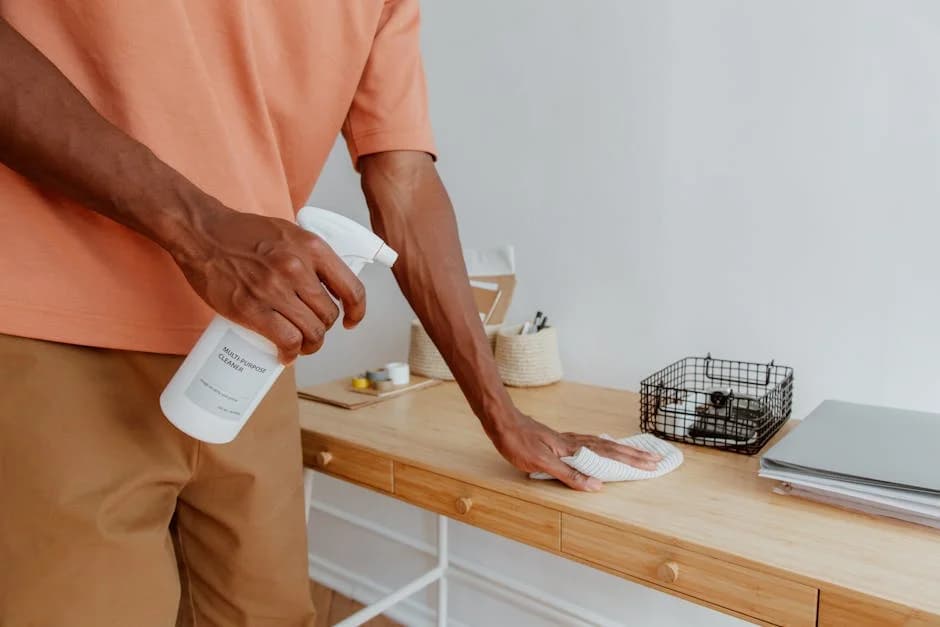
High-touch surfaces in healthcare facilities are the highest-risk transmission points for pathogen spread and require disinfection at greater frequency than surfaces that are rarely contacted.
Priority high-touch surfaces for scheduled disinfection throughout the day (not just during terminal cleaning):
- Elevator buttons — interior and exterior, all floors
- Stairwell handrails
- Door handles throughout the facility
- Nursing station surfaces — counters, keyboards, phone handsets, workstation touchscreens
- Patient room door handles and light switches (between scheduled terminal cleans)
- Restroom fixtures in common areas — handles, dispensers, and flush controls
- Waiting area seating armrests
- Reception desk surfaces
The frequency of high-touch surface disinfection should be calibrated to facility traffic and the specific pathogens of concern. Minimum once-daily is a baseline for low-risk areas; multiple times per day is appropriate for high-traffic areas and during periods of elevated infection risk.
Medical Equipment Cleaning and Disinfection
Healthcare facilities contain a wide variety of medical equipment that requires specific cleaning approaches:
Non-critical equipment (contacts intact skin only — blood pressure cuffs, oximeters, stethoscopes): Requires low-level disinfection between patients using an EPA-registered product appropriate for the item and pathogen.
Semi-critical equipment (contacts mucous membranes or non-intact skin): Requires at minimum high-level disinfection or sterilization depending on the specific device category.
Environmental services scope: Environmental cleaning staff clean the external surfaces of stationary medical equipment (vital sign monitors, IV pumps, ventilators) as part of terminal room cleaning. Disinfection of patient-contact components of medical devices is typically a nursing responsibility following clinical protocols specific to those devices.
Floor Care in Healthcare Settings
Healthcare facility floor maintenance requires consideration of both hygiene and patient safety:
Vacuuming: HEPA-filtered vacuums are required in healthcare environments to prevent re-dispersal of pathogens captured in the filter.
Mopping: Flat microfiber mop systems with single-use pads (laundered and not reused in the same area) provide better pathogen capture than conventional string mops. Mop solution should be changed frequently — mopping large areas with the same solution redistributes contamination rather than removing it.
Disinfectant selection for floors: Not all disinfectants are appropriate for floor use — some formulations that are effective on surfaces can leave films that create slip hazards on hard floors. Use floor-specific disinfectants validated for healthcare floor surfaces.
High-floor-traffic areas: Entrances, corridors, and waiting areas in healthcare facilities see high traffic that accelerates floor surface wear. Maintaining floor finish coatings reduces slip risk and makes floor cleaning more effective — contamination does not penetrate sealed floor surfaces the way it penetrates worn or bare surfaces.
Why Healthcare Facilities Choose Professional Cleaning Partners
The operational complexity of healthcare cleaning compliance — maintaining current regulatory knowledge, sustaining a comprehensive staff training program, documenting all activities, ensuring consistent execution across all shifts — creates a strong case for professional service partnerships.
Professional healthcare cleaning service providers bring:
Pre-trained staff: Healthcare-specific training in infection control, bloodborne pathogen handling, PPE, and clinical cleaning protocols — so the facility does not need to develop and maintain these training programs internally.
Current regulatory knowledge: Professional providers maintain awareness of changing OSHA, CDC, CMS, and Joint Commission requirements as a core operational function.
Quality assurance systems: Inspection protocols, cleaning logs, and documented accountability structures that in-house programs often lack.
Surge capacity: The ability to scale staffing during outbreak situations, facility expansions, or accreditation preparation — without the recruitment and onboarding burden that in-house programs face.
Appropriate insurance: Commercial cleaning contractors carry insurance coverage appropriate for healthcare environments, including completed operations and professional liability.
Creating a Healthier Healthcare Facility
Effective healthcare facility hygiene is not a single program element — it is the integrated result of proper cleaning methods, appropriate products, trained personnel, documented protocols, and consistent execution across all shifts and areas.
Mega Service Solutions provides healthcare cleaning services built around these requirements — not adapted from general commercial programs. Our approach begins with a facility assessment that evaluates your specific patient population, traffic patterns, and regulatory requirements, then builds a customized program that addresses your environment's specific needs.
Contact us today to schedule a healthcare facility consultation and assessment. Let us demonstrate what a professionally managed healthcare cleaning program delivers for your patients, your staff, and your facility's regulatory standing.
Frequently Asked Questions
What cleaning standards apply to healthcare facilities in Florida?
Florida healthcare facilities are regulated by the Agency for Health Care Administration (AHCA) and must meet infection control standards including OSHA bloodborne pathogen protocols, CDC environmental hygiene guidelines, and accreditation standards from The Joint Commission or AAAHC. Mega Service Solutions trains crews in healthcare-specific protocols and uses EPA-registered hospital-grade disinfectants.
How is cleaning a medical facility different from regular commercial cleaning?
Healthcare cleaning requires higher disinfection standards, proper handling of potentially contaminated materials, knowledge of infection control zones, and use of hospital-grade products. Technicians must understand isolation room protocols, sterile field boundaries, and proper PPE usage. Mega Service Solutions specializes in healthcare cleaning with trained, background-checked crews.
Does Mega Service Solutions serve businesses throughout Florida?
Yes. Mega Service Solutions is headquartered in Tampa, FL and serves businesses statewide — including Tampa, Orlando, Miami, Jacksonville, Fort Lauderdale, Clearwater, St. Petersburg, Sarasota, Fort Myers, Naples, Tallahassee, Boca Raton, and Hollywood. We also serve clients nationwide. Call (813) 501-5001 or visit megasvs.com/get-a-quote to request a free assessment.
How do I get a quote from Mega Service Solutions?
Getting a quote is simple. Call us at (813) 501-5001 (available 24/7) or submit a request at megasvs.com/get-a-quote. We'll schedule a free, no-obligation facility walkthrough, assess your needs, and provide a custom proposal within 24–48 hours. There's no commitment required.
Written by
Mega Service Solutions
Tampa’s SBE & MBE certified commercial cleaning experts. Serving 500+ businesses across Florida. Learn more about our team and commitment to quality.
About our team →