Why Office Wall Cleaning Matters
Office walls are easy to overlook in a cleaning program. Floors, surfaces, and restrooms receive consistent attention because their condition is immediately apparent. Walls accumulate grime gradually — dust settling on horizontal ledges and trim, fingerprints building near light switches and door frames, scuffs and marks from daily contact, and microscopic allergens distributing across painted surfaces.
By the time wall soiling is visually obvious, it has been affecting the environment for some time.
The case for regular office wall cleaning rests on several practical benefits:
Improved air quality: Walls function as passive dust collectors. Accumulated dust, pet dander, pollen, and skin cells on wall surfaces can become airborne during ventilation cycles or physical disturbance, degrading indoor air quality. Regular wall cleaning removes these accumulated contaminants.
Enhanced hygiene: Bacteria and allergens colonize porous painted surfaces, particularly in high-touch areas near switches, handles, and doorways. Regular cleaning addresses these microbial accumulation points.
Professional impression: Clean walls create a professional, well-maintained appearance for clients, visitors, and employees. Dirty walls communicate neglect, regardless of how clean the floors and surfaces may be.
Employee productivity: Research on workspace environments consistently shows that cleaner, more organized, and more aesthetically maintained spaces support better focus and higher employee satisfaction.
Asset protection: Paint and wall finishes degrade faster when contaminants are allowed to accumulate. Regular cleaning extends the period between costly repainting projects.
Our commercial janitorial services include periodic wall cleaning as part of comprehensive office maintenance programs.
Identifying Your Wall Paint Type First
The appropriate wall cleaning method depends entirely on the paint finish. Using the wrong approach on the wrong finish causes permanent damage — streaking, dulling, and surface degradation.
Flat and matte finishes: These are the most delicate. They have minimal sheen and are used in low-traffic areas like private offices and conference rooms. Flat finishes must be dry-cleaned only — vacuuming and dry dusting. Any moisture cleaning, even with a barely damp cloth, will remove the paint and leave shiny spots.
Eggshell finish: A slight sheen that is more washable than flat finishes. These can be cleaned with a barely damp cloth and mild cleaning solution for spot treatment, but require care to avoid streaking.
Satin finish: More durable than eggshell, commonly used in hallways, break rooms, and areas with moderate traffic. Satin can be cleaned with a damp cloth and mild cleaner.
Semi-gloss and gloss finishes: The most durable and washable. Commonly used in restrooms, kitchens, and high-traffic areas. These finishes tolerate wet cleaning with appropriate cleaning solutions.
If you are uncertain about the paint finish in your facility, test any cleaning method on an inconspicuous section before proceeding.
Step-by-Step Process for Cleaning Office Walls
Step 1: Remove Dust Before Applying Any Moisture
Applying wet cleaning solutions to a dusty wall creates a paste that is harder to remove and can leave residue and streaks. Always begin with dry dust removal.
Use a vacuum cleaner with a soft brush attachment to move systematically across wall surfaces from top to bottom. Pay particular attention to:
- Ceiling-to-wall junctions where dust accumulates
- Baseboards and floor-level trim
- The areas around electrical outlets and light switches
- Window trim and door frames
A microfiber duster or electrostatic dust cloth can follow the vacuum to capture any remaining surface dust. Microfiber is preferable to feather dusters, which distribute rather than capture particles.
Step 2: Address Spot Marks and Scuffs
Before applying any general wall cleaning, identify and address specific marks, scuffs, and stains with targeted treatment.
For pencil marks and minor scuffs: An art gum eraser addresses many marks on durable paint finishes without moisture. Test on an inconspicuous area first.
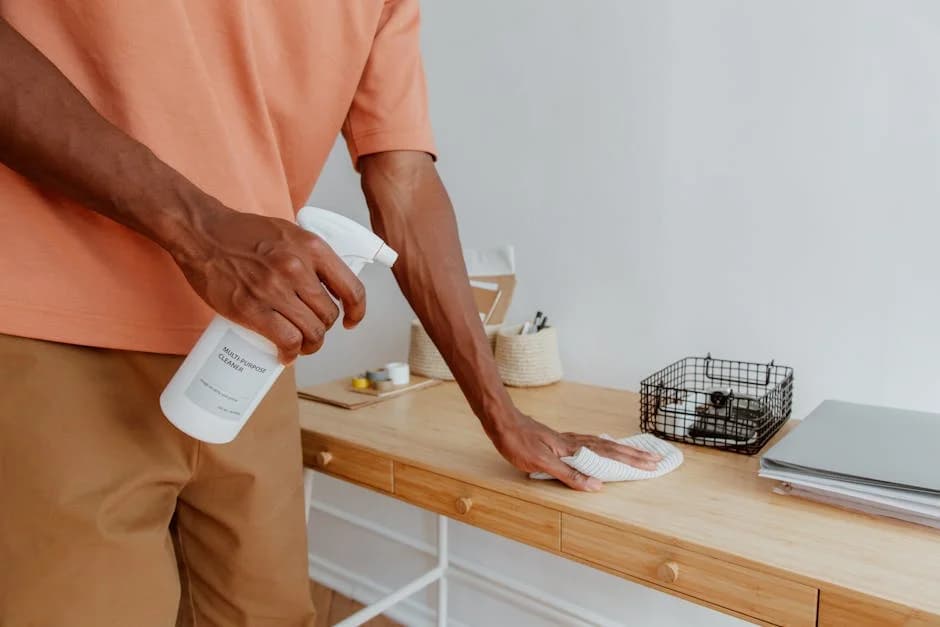
For fingerprints and light marks on washable finishes: A barely damp microfiber cloth with a small amount of mild dish soap solution addresses fingerprints effectively on satin or semi-gloss surfaces. Apply with gentle circular motion, then wipe with a clean damp cloth, then dry with a clean dry cloth.
For stubborn marks: A magic eraser-type melamine foam pad can address stubborn marks on durable paint finishes. Use with caution and test first — these products are mildly abrasive and can dull glossy finishes.
Step 3: Prepare the Cleaning Solution
For washable finishes (satin, semi-gloss, gloss), prepare a mild cleaning solution:
- Warm water in a clean bucket
- Small amount of mild dish soap or commercial all-purpose cleaner appropriate for painted surfaces
- A second bucket with clean rinse water
Avoid:
- Harsh chemical cleaners that can strip or discolor paint
- Abrasive cleaners or scrubbing materials
- Undiluted cleaning concentrates
- Ammonia-based products on certain paint formulations
Step 4: Clean in Sections
Work systematically across wall surfaces in manageable sections. Clean from top to bottom within each section — loose contamination that falls during cleaning will land on surfaces you have not yet cleaned.
Use a soft sponge or microfiber cloth, well-wrung (barely damp is the goal, not wet). Apply gentle pressure in overlapping strokes, following any directional texture in the paint.
After cleaning each section, rinse with a clean damp cloth and dry with a clean dry cloth before moving to the next section. This prevents streaking from cleaning solution residue.
Step 5: Address High-Touch Zones
Light switches, door frames, wall-mounted panels, and areas near workstations receive much heavier contact than general wall surfaces and require more frequent attention. These high-touch zones should be addressed as part of regular cleaning cycles — not only during periodic wall cleaning events.
For high-touch areas on semi-gloss or gloss finishes, an EPA-registered disinfectant appropriate for painted surfaces can be applied following physical cleaning.
How Often Should Office Walls Be Cleaned?
The appropriate frequency depends on the specific area within the facility:
- High-touch areas (around switches, near doorways, at reception) — spot cleaning weekly, full cleaning monthly
- Break rooms and kitchens — monthly due to cooking residue and heavier contamination
- Restrooms — monthly with standard restroom cleaning protocols
- Private offices and conference rooms — quarterly for general walls; spot-cleaning as needed
- Hallways and common areas — quarterly
Annual full-facility wall cleaning allows for inspection of any areas with developing mold, moisture staining, or paint degradation that requires maintenance attention.
When Professional Wall Cleaning Is the Right Choice
Comprehensive facility wall cleaning — particularly in large offices, multi-floor commercial buildings, and facilities with high ceilings — requires professional services. The labor involved in proper preparation, systematic cleaning, and follow-up is significant, and the risk of damage to paint finishes from improper technique is real.
Mega Service Solutions provides comprehensive deep cleaning services that include wall cleaning as part of periodic facility deep cleaning programs. Our teams understand the surface requirements of different paint finishes and use appropriate products and techniques for each application.
Professional wall cleaning as part of an annual deep cleaning program protects your paint investment, improves air quality, and maintains the professional appearance of your facility without the risk of surface damage from improper DIY technique.
Get a Comprehensive Office Cleaning Program
Mega Service Solutions designs office cleaning programs that address every surface in your facility — floors, surfaces, restrooms, and yes, walls — on appropriate schedules with appropriate techniques.
Contact us today to request a consultation and quote. We will assess your facility, understand your priorities, and build a cleaning program that keeps every element of your workspace in professional condition.
Frequently Asked Questions
What should businesses know about clean commercial office walls?
Professional clean commercial office walls from Mega Service Solutions is tailored to your facility's specific needs and industry requirements. We conduct a free facility assessment before recommending a service plan, ensuring the scope, frequency, and methods match your operational environment. All services are performed by trained, background-checked crews using commercial-grade equipment.
How much does professional clean commercial office walls cost for a commercial facility?
Cost depends on facility size, service frequency, scope of work, and access requirements. Mega Service Solutions provides free, no-obligation assessments and custom quotes for every facility. Call (813) 501-5001 or submit a quote request at megasvs.com to receive a proposal tailored to your facility.
Does Mega Service Solutions serve businesses throughout Florida?
Yes. Mega Service Solutions is headquartered in Tampa, FL and serves businesses statewide — including Tampa, Orlando, Miami, Jacksonville, Fort Lauderdale, Clearwater, St. Petersburg, Sarasota, Fort Myers, Naples, Tallahassee, Boca Raton, and Hollywood. We also serve clients nationwide. Call (813) 501-5001 or visit megasvs.com/get-a-quote to request a free assessment.
How do I get a quote from Mega Service Solutions?
Getting a quote is simple. Call us at (813) 501-5001 (available 24/7) or submit a request at megasvs.com/get-a-quote. We'll schedule a free, no-obligation facility walkthrough, assess your needs, and provide a custom proposal within 24–48 hours. There's no commitment required.
Written by
Mega Service Solutions
Tampa’s SBE & MBE certified commercial cleaning experts. Serving 500+ businesses across Florida. Learn more about our team and commitment to quality.
About our team →