The phrase "healthcare cleaning" means something very specific in professional environmental services — and it is categorically different from general commercial janitorial service. Understanding what healthcare cleaning actually looks like in practice helps medical facility administrators evaluate providers accurately and set appropriate expectations for their cleaning programs.
This post describes what a professional healthcare cleaning program involves, from staff qualifications to zone-specific protocols to documentation requirements.
Trained and Credentialed Staff
The first and most fundamental distinction in healthcare cleaning is staff qualification. General commercial cleaning staff receive basic training in cleaning procedures. Healthcare cleaning staff require training specific to healthcare environments, infection control principles, and the regulatory requirements that govern medical facilities.
Professional healthcare cleaning staff training covers:
Infection control fundamentals. Staff must understand how pathogens spread in healthcare environments, why standard commercial disinfectants are sometimes insufficient, and how their cleaning procedures directly affect patient safety outcomes.
Personal protective equipment (PPE) use. Healthcare cleaning staff work in environments where they may encounter body fluids, contaminated surfaces, and patients with infectious conditions. Proper PPE selection, donning, doffing, and disposal procedures are mandatory.
Contact isolation protocols. When patients are on contact precautions for specific organisms (C. diff, MRSA, VRE), cleaning staff must follow specific procedures before, during, and after cleaning those rooms — including dedicated equipment that does not leave the room during the cleaning process.
Product knowledge. Staff must understand which disinfectants are registered for which pathogens, at what concentrations, with what contact times, and on which surface types. A disinfectant that is effective against MRSA may not be appropriate for C. diff, which requires sporicidal agents.
Documentation procedures. Healthcare cleaning staff are responsible for completing cleaning logs, noting any conditions that require reporting, and supporting the documentation systems that healthcare facilities require for regulatory compliance.
Zone-Based Cleaning Protocols
Healthcare facilities are not uniform spaces — different areas have different infection risk levels and require different cleaning approaches. A professional healthcare cleaning program applies zone-based protocols that match cleaning intensity to actual risk.
Critical care and isolation areas — ICUs, isolation rooms, operating rooms, and procedure rooms — receive the highest-intensity cleaning protocols. These areas are cleaned more frequently, with stronger disinfectants, more thorough high-touch surface coverage, and more detailed documentation. Room terminal cleaning when a high-risk patient is discharged is particularly thorough.
General patient care areas — standard patient rooms, patient bathrooms, and nurse stations — receive daily comprehensive cleaning with appropriate disinfection of all high-touch surfaces. Patient bathrooms, which are a primary transmission pathway for many pathogens, receive thorough daily disinfection.
Diagnostic and treatment areas — exam rooms, physical therapy areas, and outpatient treatment spaces — are cleaned between each patient with attention to the specific surfaces that receive patient contact during each visit.
Waiting and reception areas — patient waiting rooms, check-in areas, and lobbies — receive regular cleaning and disinfection of high-touch surfaces throughout the day. Medical waiting rooms concentrate patients who may have active infectious conditions, creating higher transmission risk than typical commercial waiting areas.
Administrative and staff areas — offices, break rooms, conference rooms — receive general commercial cleaning protocols with recognition that clinical contamination may be introduced by staff moving between areas.
The High-Touch Surface Priority
One of the clearest distinctions between healthcare cleaning and general commercial cleaning is the systematic prioritization of high-touch surfaces. In healthcare environments, the following surfaces are specifically prioritized in cleaning protocols because of their infection transmission significance:
- Door handles on both sides of every door, including restroom doors
- Light switches and thermostat controls
- Call buttons and nurse call panels
- Bed rails and adjustment controls
- Over-bed table surfaces
- IV pole handles and pump controls
- TV remotes and entertainment controls
- Toilet flush handles and toilet seats
- Faucet handles (including the underside)
- Paper towel and soap dispenser levers
- Clipboard surfaces and signing areas
These are not surfaces that look dirty or that patients notice particularly — but they are surfaces that hands touch constantly, creating high transmission potential. A healthcare cleaning program that does not address these surfaces specifically is leaving significant infection risk unaddressed.
Disinfectant Selection and Application
Healthcare cleaning programs use EPA-registered disinfectants specifically formulated for healthcare pathogen kill claims. General-purpose disinfectants marketed for commercial use may not carry the specific pathogen claims required for healthcare settings.
Contact time compliance is a critical factor that distinguishes professional healthcare cleaning from inadequate cleaning. Every EPA-registered disinfectant has a required contact time — the minimum duration that the product must remain wet on a surface to achieve its stated kill claims. This is typically 1–10 minutes depending on the product.
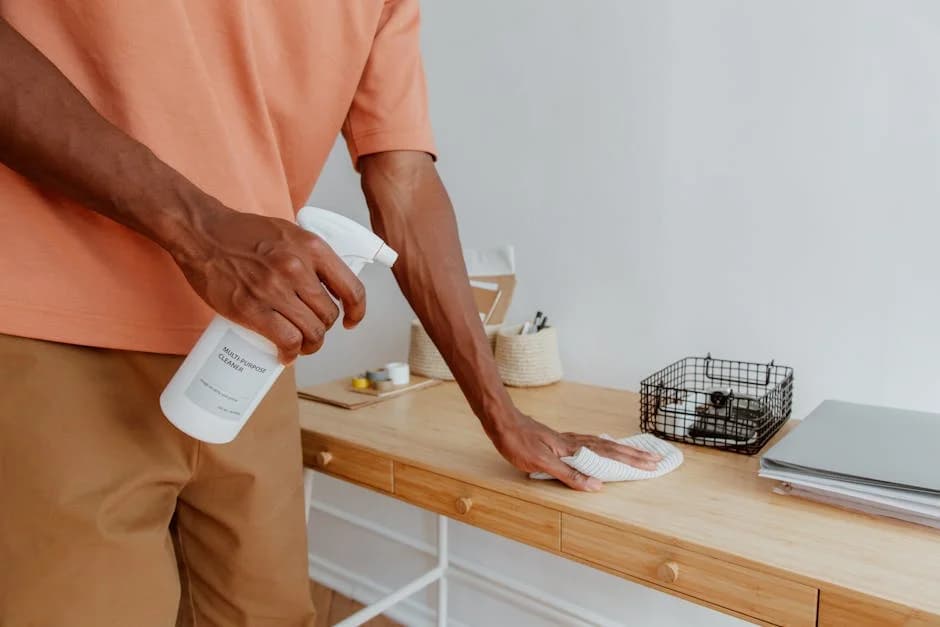
A cleaning staff member who sprays a surface and immediately wipes it is not disinfecting — they are cleaning in the simplest sense while providing false assurance of disinfection. Proper healthcare cleaning protocols require applying sufficient product and allowing proper contact time before wiping, consistently on every surface.
Professional healthcare cleaning staff are trained on contact time requirements and accountable for following them.
Documentation and Accountability Systems
Healthcare facilities require documentation that general commercial cleaning does not. A professional healthcare cleaning program includes:
Cleaning logs for each area, documenting the time, products used, and staff member responsible for each cleaning episode. For high-risk areas, documentation occurs for every cleaning event.
Terminal cleaning checklists that document the completion of every required task in end-of-patient-stay room cleanings. These checklists are increasingly required by accreditation bodies as evidence of systematic protocol adherence.
Product and dilution logs that document which EPA-registered products are in use, at what concentrations, and how they are being prepared. Incorrect dilution of disinfectant concentrates produces solutions that do not achieve their kill claims.
Training records for all staff performing healthcare cleaning, documenting initial training completion and any required refresher training.
Inspection and audit records from quality monitoring programs, corrective action documentation, and trend analysis showing performance over time.
This documentation is not administrative overhead — it is the accountability infrastructure that ensures healthcare cleaning is performed to the required standard consistently, not just when someone is watching.
What Healthcare Cleaning Looks Like from the Outside
For a medical facility administrator observing a professional healthcare cleaning program in action, it looks like this:
- Staff arrive with clearly assigned zones and documented task lists
- PPE is donned before entering patient care areas and doffed appropriately between areas
- Cleaning proceeds systematically — top to bottom, back to front — preventing re-contamination of cleaned surfaces
- Disinfectant is applied and allowed to dwell before wiping, not immediately removed
- High-touch surfaces receive explicit attention, not just floor and prominent surfaces
- Room terminal cleanings follow a written checklist and take significantly longer than routine daily cleaning
- Completed cleaning is logged with time, staff identity, and product information
If a cleaning program in your healthcare facility does not look like this, it is not meeting the standard that healthcare environments require.
Ready to evaluate your healthcare facility's cleaning program? Contact Mega Service Solutions for a healthcare cleaning assessment and free quote. We design programs specific to your facility type, regulatory requirements, and patient population.
Frequently Asked Questions
What cleaning standards apply to healthcare facilities in Florida?
Florida healthcare facilities are regulated by the Agency for Health Care Administration (AHCA) and must meet infection control standards including OSHA bloodborne pathogen protocols, CDC environmental hygiene guidelines, and accreditation standards from The Joint Commission or AAAHC. Mega Service Solutions trains crews in healthcare-specific protocols and uses EPA-registered hospital-grade disinfectants.
How is cleaning a medical facility different from regular commercial cleaning?
Healthcare cleaning requires higher disinfection standards, proper handling of potentially contaminated materials, knowledge of infection control zones, and use of hospital-grade products. Technicians must understand isolation room protocols, sterile field boundaries, and proper PPE usage. Mega Service Solutions specializes in healthcare cleaning with trained, background-checked crews.
Does Mega Service Solutions serve businesses throughout Florida?
Yes. Mega Service Solutions is headquartered in Tampa, FL and serves businesses statewide — including Tampa, Orlando, Miami, Jacksonville, Fort Lauderdale, Clearwater, St. Petersburg, Sarasota, Fort Myers, Naples, Tallahassee, Boca Raton, and Hollywood. We also serve clients nationwide. Call (813) 501-5001 or visit megasvs.com/get-a-quote to request a free assessment.
How do I get a quote from Mega Service Solutions?
Getting a quote is simple. Call us at (813) 501-5001 (available 24/7) or submit a request at megasvs.com/get-a-quote. We'll schedule a free, no-obligation facility walkthrough, assess your needs, and provide a custom proposal within 24–48 hours. There's no commitment required.
Written by
Mega Service Solutions
Tampa’s SBE & MBE certified commercial cleaning experts. Serving 500+ businesses across Florida. Learn more about our team and commitment to quality.
About our team →